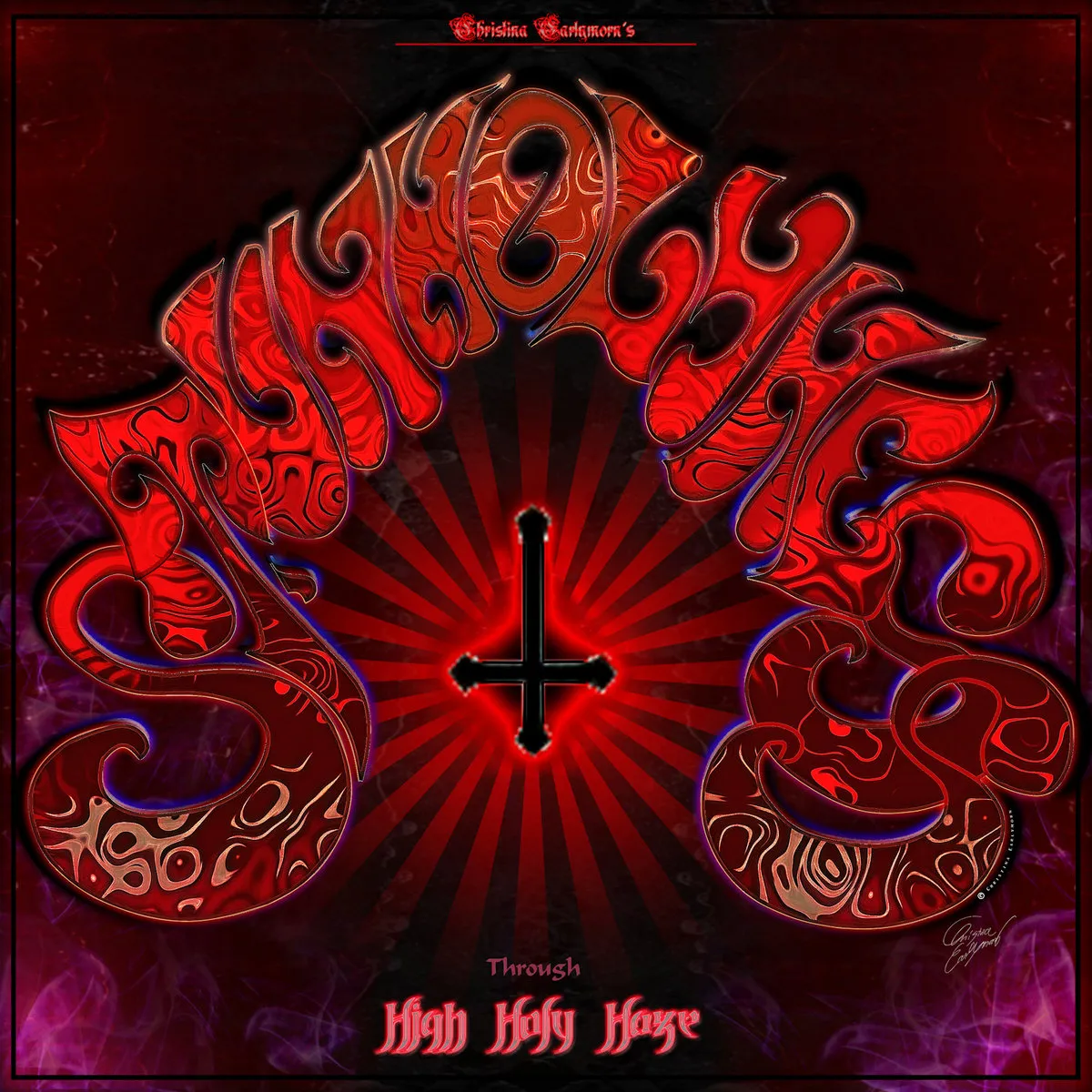
Released on Christmas Day 2025, Through High Holy Haze arrives with the timing of a deliberate provocation. St. Unholyness is essentially Christina Earlymorn working alone, she plays all the instruments, sings, records, mixes, masters, and designs the artwork herself, and that total creative ownership shows in every corner of the record. This is music made without committee, without compromise, and with a directness that can feel almost confrontational.
The album opens with “Heaven’s Harem,” an invitation to shake off inherited piety before the title track arrives to seal the deal. “Through High Holy Haze” is the record’s mission statement: slow, suffocating riffs underneath imagery of Babylon crumbling and Lucifer’s light cutting through centuries of religious conditioning. Earlymorn doesn’t traffic in horror-movie occultism, the darkness here is psychological, the black flame a metaphor for the self-determination that organised religion tried to extinguish. The track builds with patience, its central riff cycling long enough that by the time it locks in fully, it carries genuine weight.
“Dampflok des Todes” shifts the focus inward, and it’s one of the most interesting things on the record. Where the title track looked outward at generational trauma, this one turns the lens on Earlymorn herself, acknowledging mistakes, vowing to stand up again, using the German word for steam locomotive as a kind of blunt-force metaphor for forward momentum. There’s something almost charming about the bilingual collision of “Volldampf voraus!” with English confessional lyrics, and the song is better for its refusal to be tidy.
“Blacktooth Brothers” is a tribute to Dimebag Darrell and Vinnie Paul, and it wears its affection plainly, referencing Pantera, Crown Royal, the lightning-fast solos and “chuggy riffs” that made the Abbott brothers legends. It’s the most straightforwardly celebratory moment on the album, a fan writing a love letter in the language she knows best. “Alchemist Blues (Extended)” then pivots toward Nikola Tesla and Carl Jung, weaving Hermetic philosophy (“as above, so below”) into a slow-burning meditation that earns its extended runtime.
The album’s final stretch is where the politics surface most directly. “Hate Response” goes after fascism and the weaponisation of religion against marginalised people with the bluntness of a sledgehammer, while “Loud and Proud” turns the energy around into something close to a rallying cry, an anthem for anyone who’s been made to feel their existence is up for debate. It’s the record’s most accessible track, built around a chorus that lands like a fist in the air rather than a boot to the chest.
Closer “St. Unholyness” strips everything back to the band’s own name chanted over a final riff, sealing the record as exactly what it always was: a statement of identity.
The production is DIY in the truest sense, rough at the edges, but coherent and honest. The guitar tone carries enough low-end to feel genuinely heavy, and the separation between instruments holds together even in the denser passages. It won’t rival a studio recording, but that was never the point. Through High Holy Haze is a document, not a product, eight songs that insist on being heard on their own terms.
Standout tracks: Through High Holy Haze, Dampflok des Todes, Loud and Proud


