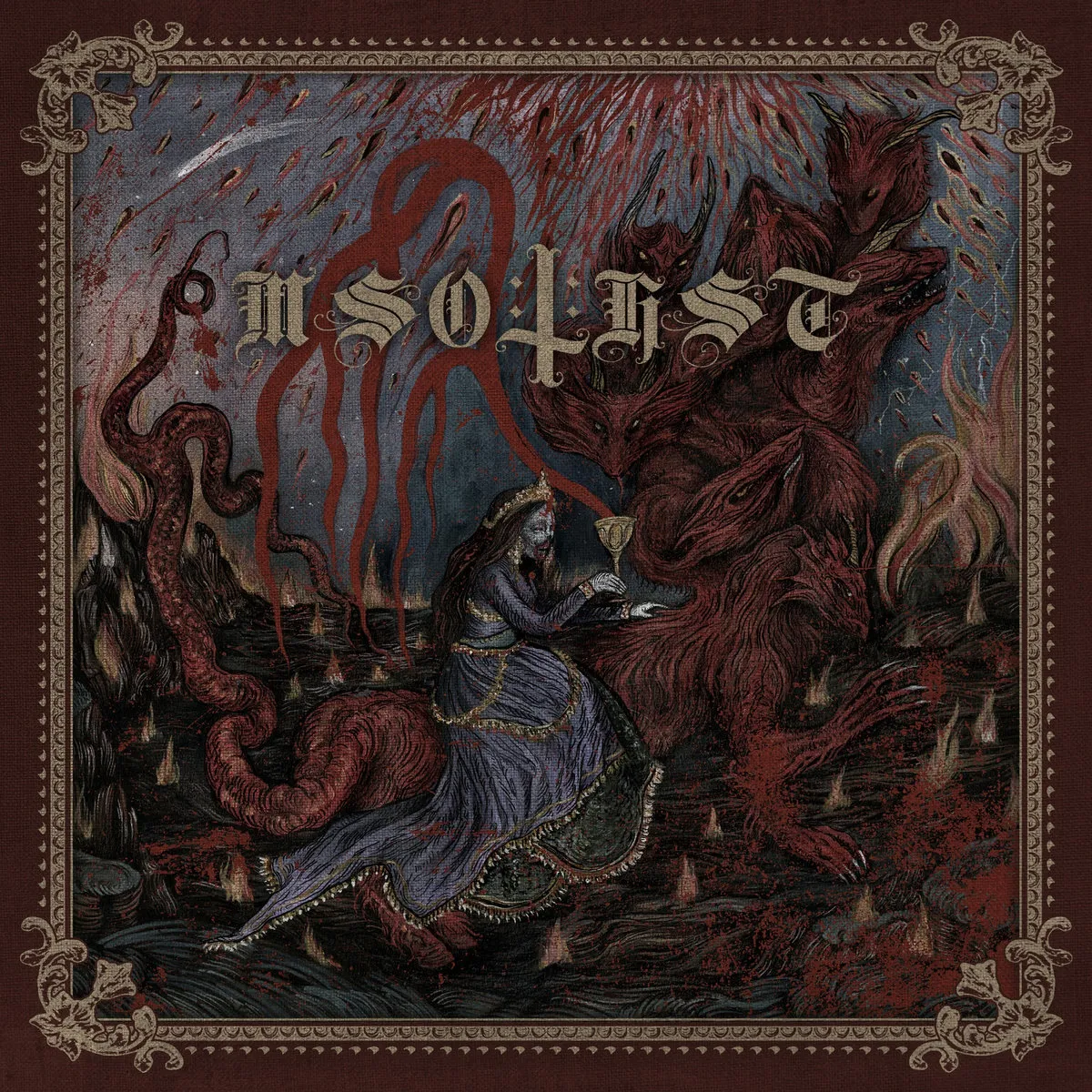
Misotheist don’t explain themselves. No lineup announcements, no interviews, no commentary, just the music, every two years or so, arriving via Terratur Possessions like a sealed letter from somewhere you’d rather not visit. De Pinte, their fourth album, translates from Norwegian as “The Tormented.” It suits. Forty-three minutes across four tracks, this is the band’s most ambitious and most unified record yet, a thing that rewards close listening without once asking you to sit still.
“Unanswered Thrice” opens at close to six minutes and sets terms immediately: the guitars move in dense, overlapping currents, the drums hitting with the kind of controlled force that makes each blast feel deliberate rather than reflexive. There’s a riff about two minutes in that does the thing good riffs do, appears to be one thing, then reveals itself as something else once the full band locks in around it. The song ends before it overstays its welcome, which is a precision the whole album shares.
“Blinded and Revealed” is the record’s most direct statement. Seven and a half minutes that never let up, not in tempo, not in intensity, not in the layering of guitars that keeps revealing new movement even on fifth or sixth listen. Where some bands use complexity as camouflage for a lack of ideas, Misotheist use it as multiplication: there’s a core idea here that’s already strong, and then everything around it makes it stronger. Fans have pointed to this track as the album’s hardest-hitting moment, and it’s difficult to disagree.
“Kjetterdom”, meaning something close to heresy or the domain of heretics, sits third, slightly more measured, the tempo pulling back just enough to let the weight land differently. It functions as a kind of bridge, though one with enough substance to stand alone. The riffing is more serpentine here, winding around the drumming rather than riding over it. By the time it ends, you’ve been set up, whether you know it or not.
Then comes the title track. Twenty-one minutes and twenty-three seconds. It opens slowly, not slowly in the sense of a gradual build, but slowly in the sense of something large moving through shallow water, the resistance visible in every motion. Around the four-minute mark it finds the first of several full-band moments, and the accumulated weight of the preceding three tracks makes it hit with a force it couldn’t carry on its own. The tempo shifts throughout are never announced; they simply arrive. A section about halfway through pulls back to near-silence, the guitars reduced to a low, almost droning register, before the whole thing reassembles and pushes through to the end. It is, without exaggeration, one of the more impressive things a heavy band has put on record in recent memory.
Terratur Possessions’ production keeps everything legible without softening it. The guitars carry genuine low-end, the drums crack without clatter, and the mix gives each instrument enough room to be heard without the kind of clinical separation that can make heavy records feel assembled rather than played.
A quick pass over the stream points to a mix choice that shapes the whole listening experience: drums and vocals sit clearly in front and lead the record’s momentum. The reverb gives the songs a broad, unified atmosphere, while the guitars tend to sit slightly further back in denser moments. The result is less about razor-sharp separation and more about weight, movement, and emotional pressure.
Standout tracks: Blinded and Revealed, De Pinte
Misotheist have been building toward something with each release, and De Pinte is where it arrives. A record that asks for your full attention and gives back considerably more.


