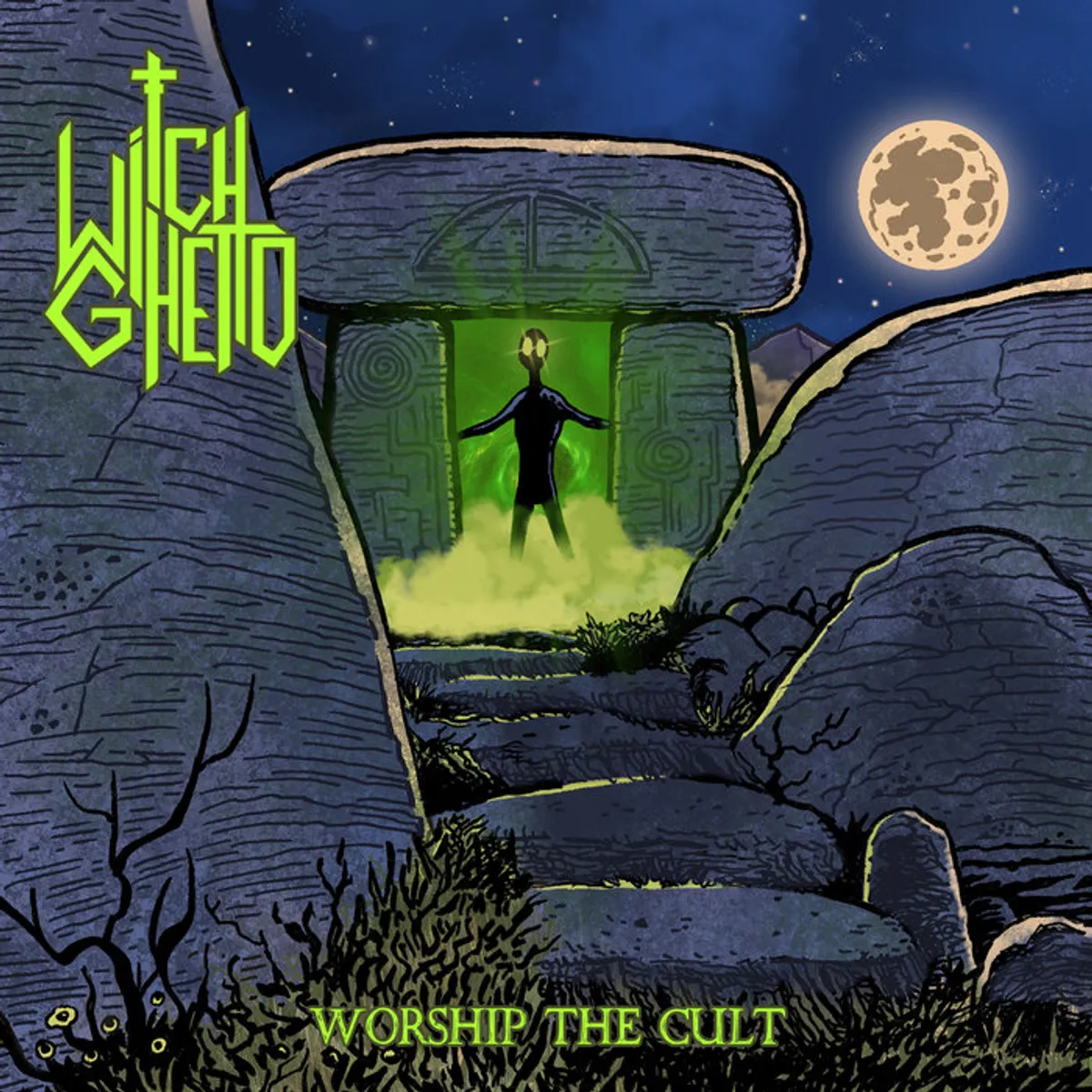
 Bandcamp
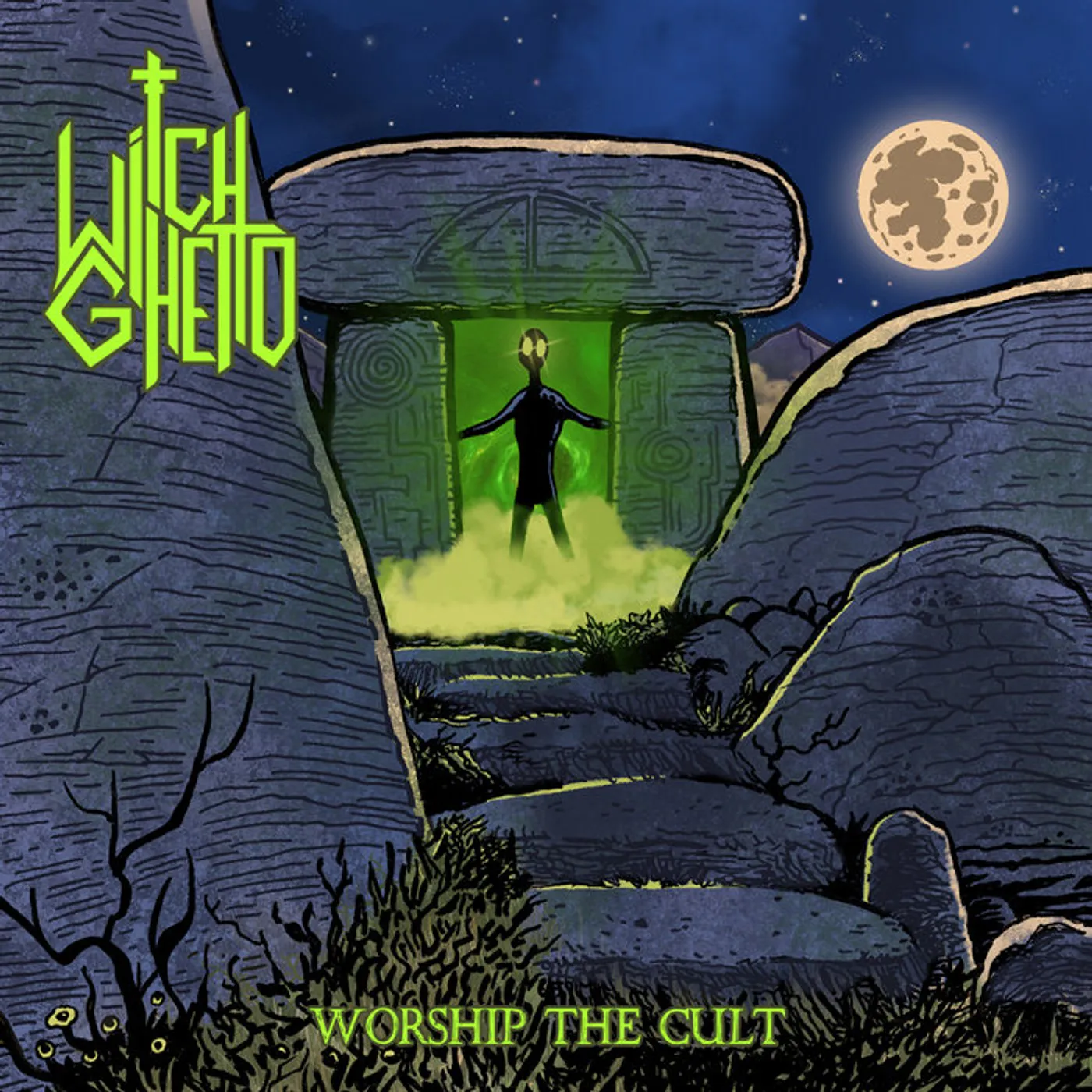
The credits on the band’s own page name four people and none of them are people. Tritolo does Infernal Screams, El Brujo handles Bloody Axes, Ancient Mariner supplies Abysmal Pulses, T. Arise plays Voodoo Drums. No label is listed, and a single line covers the writing: everything composed, arranged and refined through blood, sweat and tears by Witch Ghetto as a whole.
The press kit fills in what the public page leaves out. Worship the Cult was recorded at Black Alley Studio and Sotto il Mare, self-produced, and mixed and mastered by Francesco Gambarini of Shiver Down. So the anonymity is pointed at listeners rather than at the people who made the record, which is a different thing from having nothing to credit.
A band can present itself as one body and still sound like four musicians taking turns. This one does not, and the measurements are the reason I believe the sleeve.
A record with one sound
Across all seven tracks the spectral centre moves within a window of 294 Hz. The low midrange, the band between 250 and 800 Hz where this kind of guitar tone lives or dies, stays between twenty and twenty three percent on every single piece. Treble sits between thirteen and just over fifteen. Average level varies by one decibel across thirty seven minutes.
That is a remarkably narrow corridor for a self-released debut, and it is the opposite of what usually happens when a band records itself. The common failure is seven tracks that each sound like the day they were captured. Worship the Cult sounds like one room, one amp setting and one decision, held for the length of the album.
The quartet formed in Verona in 2022 and they describe what they do as old epic doomish fuckin’ heavy metal, which is both accurate and the right register for a record whose blurb invokes cromlechs on the steppes and ziggurats under the sand.
Where the uniformity breaks
Two tracks step outside it, and they do it on dynamics rather than tone.
“Riddle of Steel” runs more than sixteen decibels from its quietest passage to its loudest, the widest on the album by a distance, and it manages that in four minutes nineteen. “Black Cloak” closes the record at seven minutes and runs fifteen. Everything else sits between five and a half and ten, and three of those sit under six and a half.
I expected the long pieces to be the open ones. They are not. “On Another Planet” and “At the Mountains of Madness” are both past six minutes and both sit in the middle of the range, while the second shortest song on the record is the one that moves most. The band is using length and dynamics as separate tools, which is more deliberate than most debuts manage.
The titles are doing work
“The Valley of Gwangi” is Harryhausen, 1969. “Riddle of Steel” is Conan. “At the Mountains of Madness” is Lovecraft. The album opens with a song named after the band and closes with “Black Cloak”, and the whole thing reads as pulp cinema rather than occultism, which matters because it sets the tone for how seriously the cult business is meant to be taken.
The lyrics match that register exactly. The title track worships a figure called the mistress of her own lust and the queen of all the dead, a jaded entity ten thousand years old, and it is pulp horror written as pulp horror rather than as belief. The sheet marks separate voices in separate colours, which fits a line-up that credits Ancient Mariner with backing vocals alongside the bass.
Where it leaves me
Recommended, and it fills a real gap. Epic and traditional doom with this much heaviness is thin on the ground, and a first album arriving this fully formed is worth your time. It is not a first recording: the demo EP Around the Stone Cross came out in October 2024, with T. Arise already behind the drums, having replaced the band’s original drummer earlier that year.
Two reservations, both real. The consistency that makes the record coherent also means that by track five you know exactly what the next minute sounds like, and only “Riddle of Steel” and “Black Cloak” break that. And this is a loud master: the median level sits just under eleven decibels below full scale, which puts it ninth loudest of the sixty five albums we have measured. In this genre that is a tradition rather than a flaw, and crucially the peaks survive it, so the record pushes without sounding crushed. Play it loud anyway, it was clearly built for that.
Start with “Riddle of Steel”. If the swing in that one lands, the other six will.
The album is thick in a specific place. Between twenty and twenty three percent of the energy on every track sits in the 250 to 800 Hz band, which is where a guitar sounds like wood and a room rather than like a speaker, and holding that across seven pieces is a production choice rather than an accident.
It is also loud. Average levels cluster between ten and eleven and a half decibels below full scale. Against the sixty five albums in our measurement set that is about two decibels hotter than the median, so it sits at the loud end without being an outlier. Peak-to-average stays between about eleven and twelve and a half, which means the loudness was bought with level and not by flattening the transients.
The dynamic spread is the one thing that is not uniform. “Riddle of Steel” moves more than sixteen decibels, “Black Cloak” fifteen, and the three tightest tracks on the record stay under six and a half. On an album this consistent in tone, that split is the main structural event.
Corrected 18 October 2026: the production credits here were taken from the Bandcamp page, which omits them. The press kit names the studios and the mixing and mastering engineer, and includes the lyrics. A second pass, at the band’s request, fixed the timing of the drummer change: T. Arise was already in the band when Around the Stone Cross was recorded.