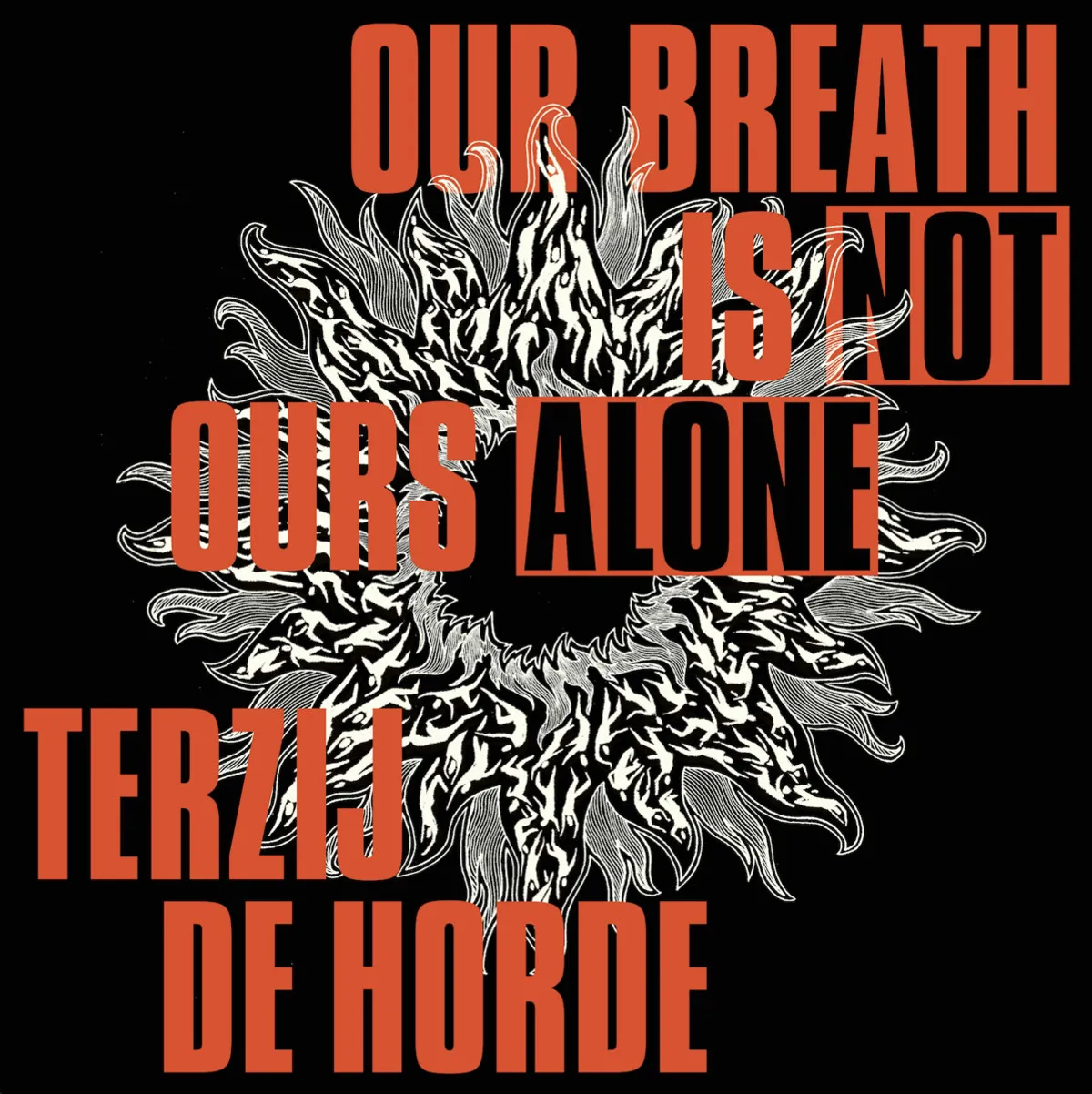
Terzij de Horde — Dutch for “set apart from the horde,” borrowed from a Hendrik Marsman poem — have never been content to stay inside the lines. The Utrecht five-piece started life as Liar Liar Cross On Fire in 2007, pivoting toward black metal’s darker atmospherics by 2010. Through Self (2015) and In One of These, I Am Your Enemy (2022), vocalist Joost Vervoort and his band have treated the genre as a delivery mechanism for something larger: political urgency, philosophical weight, the kind of confrontation that doesn’t end when the music stops. Our Breath Is Not Ours Alone, their third full-length, arrives through Church Road Records with a framework borrowed from sociologist Hartmut Rosa: the idea that modern life systematically cuts us off from the resonance we need to feel alive.
It’s a heady premise. What matters is whether the music carries it, and it does.
“Each Breath A Flame” opens the record with ninety seconds of tension-building before “Raise Them Towards The Sun” detonates. The track wastes nothing — tremolo lines collide with hardcore-paced drumming while the vocals alternate between blackened shrieks and a raw, throat-scraping delivery that owes as much to Converge as to Oathbreaker. The production, handled by Quintijn Verhoef at Independent Studio and mastered by Arthur Rizk, gives guitarists Demian Snel and Jelle Agema a brightness that cuts without sounding thin. There’s air in this mix, which is rare for music this dense.
“The Shadows Of Prefiguration” slows the tempo just enough to let the riffs breathe. The song builds around a central melodic phrase that returns in different harmonic contexts, each iteration adding weight. It’s the kind of writing that rewards repeated listens — the architecture reveals itself gradually. “A Hammer To The Great Matter Of Birth And Death” is the album’s centrepiece, nearly eight minutes of escalating intensity. The title reads like a manifesto, and the music matches: blast sections dissolve into passages of eerie calm before the whole thing erupts again. There’s a discipline to the dynamics that keeps the aggression purposeful rather than exhausting.
“The All-Consuming Work Of The Soul’s Foreclosing” packs its punch into the shortest runtime on the record. Four and a half minutes of relentless forward motion, the hardcore influence at its most visible. “Justice Is Not Enough To Leave The House Of Modernity” — the most explicitly political title here — channels that energy into something more atmospheric. The guitars open up, the pace shifts between crushing and contemplative, and there’s a passage around the four-minute mark where Johan van Hattum’s bass takes the lead in a way that reshapes the song entirely.
Then there’s “Discarding All Adornments.” The closer, and the album’s longest track at nine and a half minutes, features Amelia Baker of Cinder Well on guest vocals. Her voice enters the mix like a different kind of weather — folk-inflected, unhurried, creating a counterpoint to the blackened fury surrounding it. The collision works because neither side compromises. Baker doesn’t soften the track; the band doesn’t overwhelm her. It’s the most genuinely surprising moment on the album, and it earns every second of its runtime.
Rizk’s mastering gives the album a wide, open sound that lets each instrument occupy its own space. The drums have a live, room-driven quality rather than a triggered precision. Guitars layer tremolo picking over thick, grinding lower-register riffs without turning to mud. The vocals sit forward in the mix, visceral and close. Baker’s guest appearance on the closer is mixed with care, her voice given genuine presence alongside the distortion rather than being pushed to the margins. The bass has surprising definition throughout, providing harmonic movement that rewards headphone listening.
Standout tracks: Raise Them Towards The Sun, A Hammer To The Great Matter Of Birth And Death, Discarding All Adornments
Rosa’s resonance theory argues that we don’t need more — more speed, more options, more control — but rather the capacity to be affected by the world, and to affect it back. As Vervoort has put it: “We wanted to focus on personal responsibility and courage, from a perspective of understanding that you are deeply connected to others in the world.” Our Breath Is Not Ours Alone is that conviction made audible. Terzij de Horde have built an album that demands engagement rather than consumption, that burns with purpose rather than performance. Set apart from the horde, and all the more vital for it.


