 Bandcamp
 The last track is the one that explains the other eleven. “a smile for the dead” waits about a minute and then brings in a voice that has not been heard yet on this record: low, clean, sung rather than barked. Up to that point Christoph Wollmann has worked almost entirely between a flat spoken delivery and a shout, and the arrival of an actual melody at the end of forty four minutes reads less like a bonus track and more like the thing the album has been circling.
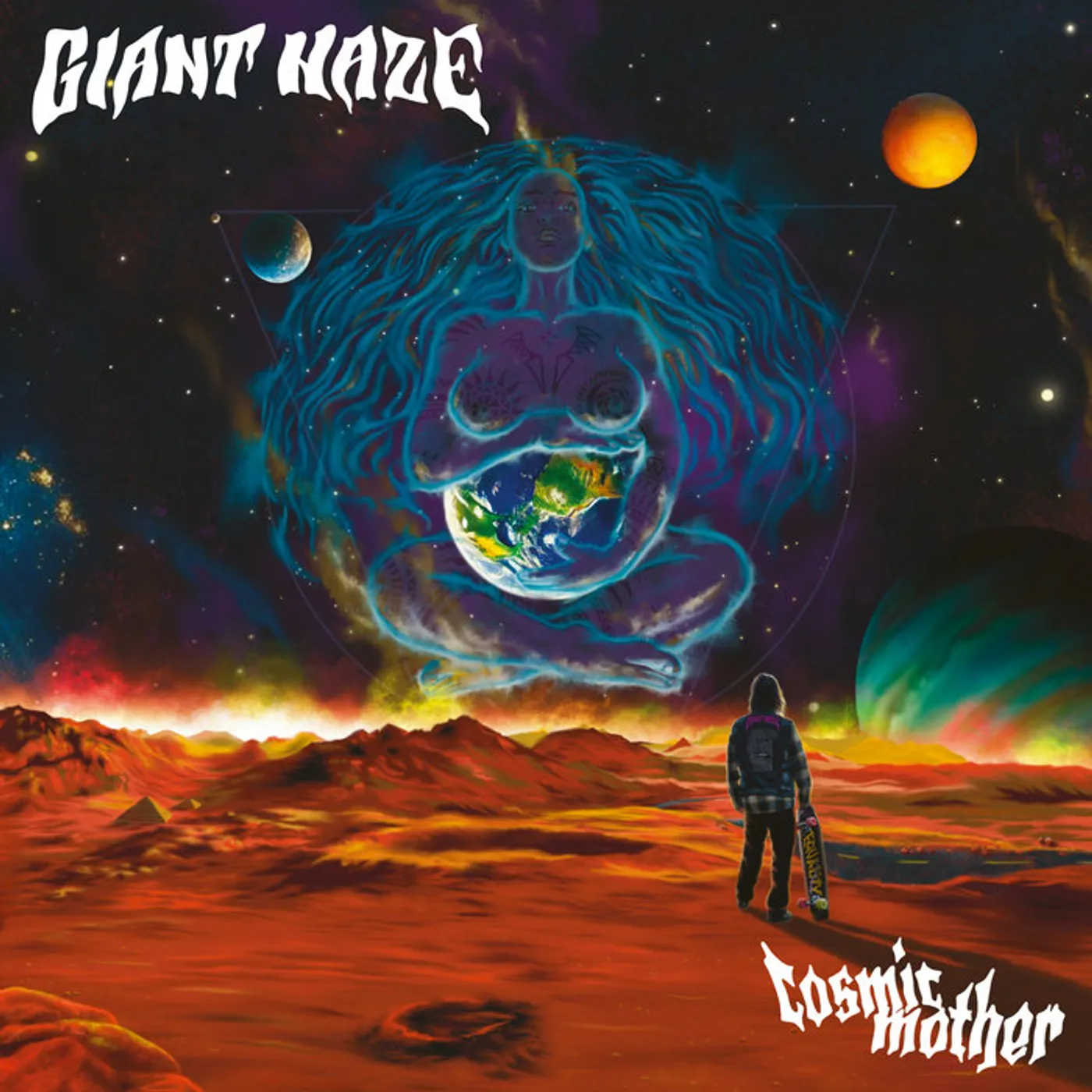
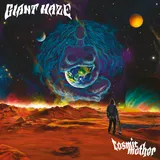
Giant Haze are four people from Kiel. They recorded at Gut Blockshagen over September 2024, Ulf Nagel mixed and mastered it, Pete Stoeckicht did the artwork, and the band’s own account is that drums and bass went down live in a single day to get the groove right. That last decision is the one you can hear without being told.
Loud and quiet, but only one colour
What a live rhythm section gives you is movement. The gaps between quiet and loud passages on Cosmic Mother are wide by the standards of anything we measure, and they are wide in a way that tracks the playing rather than the processing: the band pulls back and leans in, and the record follows.
What it does not give you is variety of sound. The frequency balance here is close to frozen. Across all twelve tracks the midrange share moves by under five points in total, the tonal centre stays inside a narrow band, and the proportion of weight at the bottom shifts by only a few points. One room, one day, one setup, twelve songs. The playing breathes and the sound does not.
Whether that reads as consistency or as sameness depends on how long you listen in one sitting. Across three or four tracks it is a band sound, the thing records spend money trying to fake. Across forty four minutes it starts to feel like a constraint the writing has to work around.
The dip at four and five
“sunrise” and “sundance” sit back to back in the middle and are the two flattest things here by a clear margin, running at roughly half the range of their neighbours. “sunrise” is ninety seconds and functions as a breather, which is fair enough. “sundance” is four minutes at the same tension and does not have that excuse. Putting both in a row at positions four and five means the album’s one soft patch is also its longest uninterrupted stretch without contrast.
Everything on either side of it holds up. “1000 tons of stone” is the widest track on the record and “king of tomorrow” is not far behind, and the back half from “pull the plug” onward is the most convincing run of songs here.
So
Recommended. This is a band playing together rather than a band assembled in a sequencer, the dynamics are real, and at twelve tracks the hit rate is better than the length suggests. The reservation is the one the recording method hands them: the record sounds identical from start to finish, and the two tracks in the middle that also stop moving make that sameness audible at exactly the wrong moment. Start at “1000 tons of stone”, then go to the closer and hear where the voice ends up.
The record moves in level and stands still in everything else. Dynamic range across the twelve tracks runs from 7.6 decibels on “sundance” to 19.3 on “1000 tons of stone” with a median of 14.2, which places the album ninth of the 48 in our measurement set. “sunrise” and “sundance” at positions four and five measure 8.0 and 7.6, against 11.1 to 19.3 for the other ten. Against that movement, the spectrum barely changes: the midrange holds 43.9 to 48.4 percent, tonal centres run 2060 to 2329 hertz, the band under two hundred and fifty hertz 21.3 to 27.9 percent and treble 13.4 to 15.6. Crest values sit between 11.7 and 14.0 decibels above average and average levels between minus 11.8 and minus 14.3, so nothing has been pushed into a wall. “sunrise” is the only track whose frequency balance differs noticeably from the rest, with the most weight at the bottom and the least midrange on the album.
Standout tracks: 1000 tons of stone, a smile for the dead, pull the plug