 Bandcamp
 Concept albums make a promise you can usually ignore. The band says the record is a journey, the sleeve has an hourglass on it, and then you get forty minutes of songs that could go in any order. Entropia Eterna, a solo project by the Italian musician who records as Hirpus, has made the rarer kind. Fractura Omnium says it moves from the noise of life to the perfect silence of thermal death across six tracks, in stages: decay, collapse, questioning, stasis, farewell, surrender. Play it with that in front of you and the record does what it says.
The shape is real
Start at the end, because that is where it is easiest to hear. “The Heart Of The Void” has no vocals, no distorted guitars and no drum kit. An acoustic guitar carries the melody, strings and pads take it over, and low drones hold the floor. It is by a distance the quietest and the darkest thing on the album, sitting far below everything else in level and with almost none of its energy above the midrange. After five tracks of blast-driven, treble-forward black metal, the spectrum simply falls out from under you.
That is not a mood piece bolted on at the end. It is the stated destination, arrived at, and you can measure the arrival.
The middle behaves too. “The Void’s Testament” and “Aeterna Dissolvunt” hold almost exactly the same tonal picture as each other and both stay inside a very narrow band between their quiet and loud passages. On most albums that would be the complaint, two tracks that will not separate. Here they are the stasis section, and they are meant to be indistinguishable. The two pieces on either side of them, the opener and “Cosmic Funeral”, swing far wider.
What it sounds like when it is still moving
Bright, for this genre. Across the five metal tracks roughly a fifth of the energy sits above five kilohertz, which pushes the guitars and cymbals well up the register and gives the record a thin, cold, glassy quality. That suits the subject. A record about heat death should not sound warm, and this one has almost no warmth in it anywhere.
“Cosmic Funeral” is the best song here and also the longest. It slows to a crawl, opens the widest gap between its quiet and loud passages of anything on the album, and gives the reverb enough room to become part of the arrangement rather than a coat of paint. It is the farewell stage and it behaves like one.
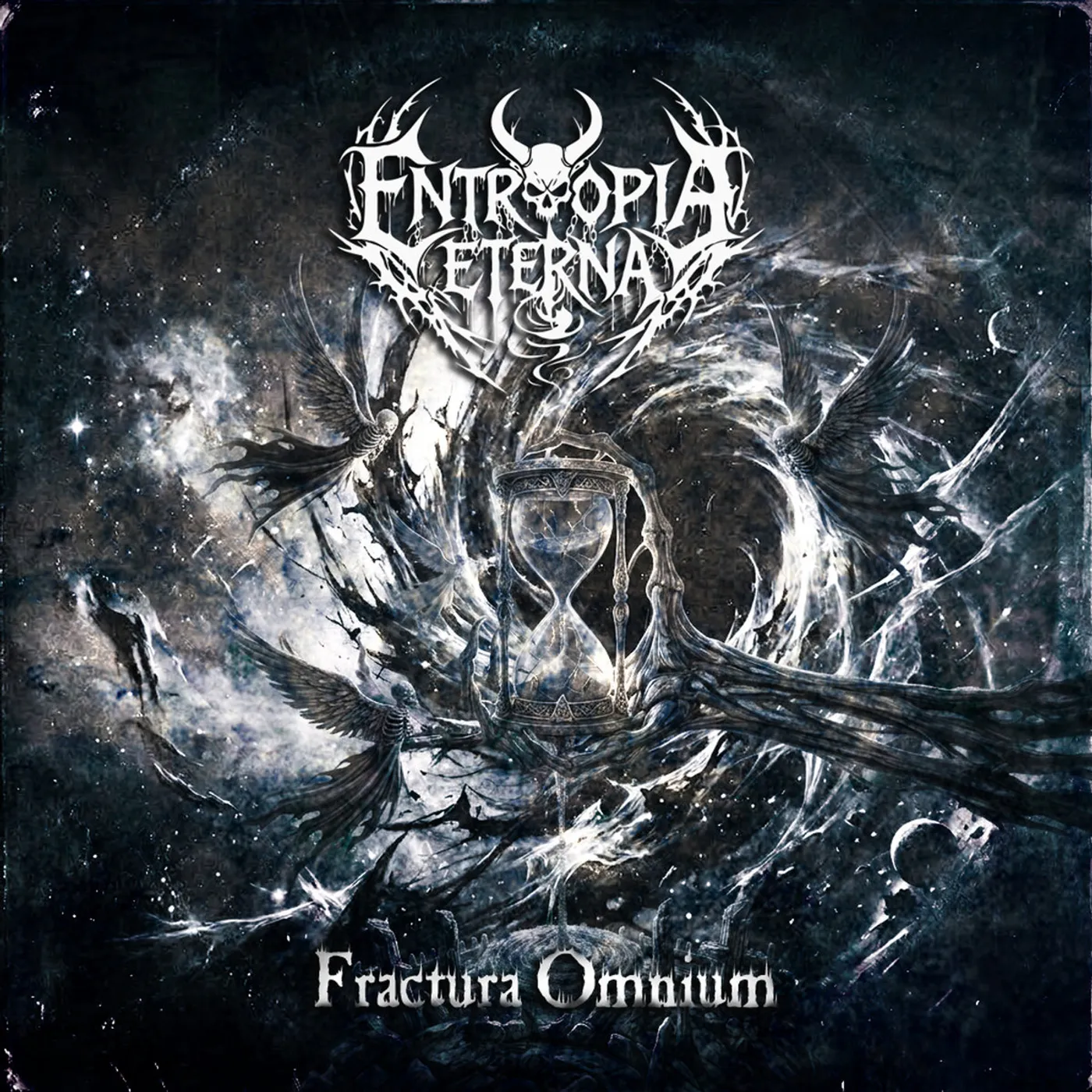
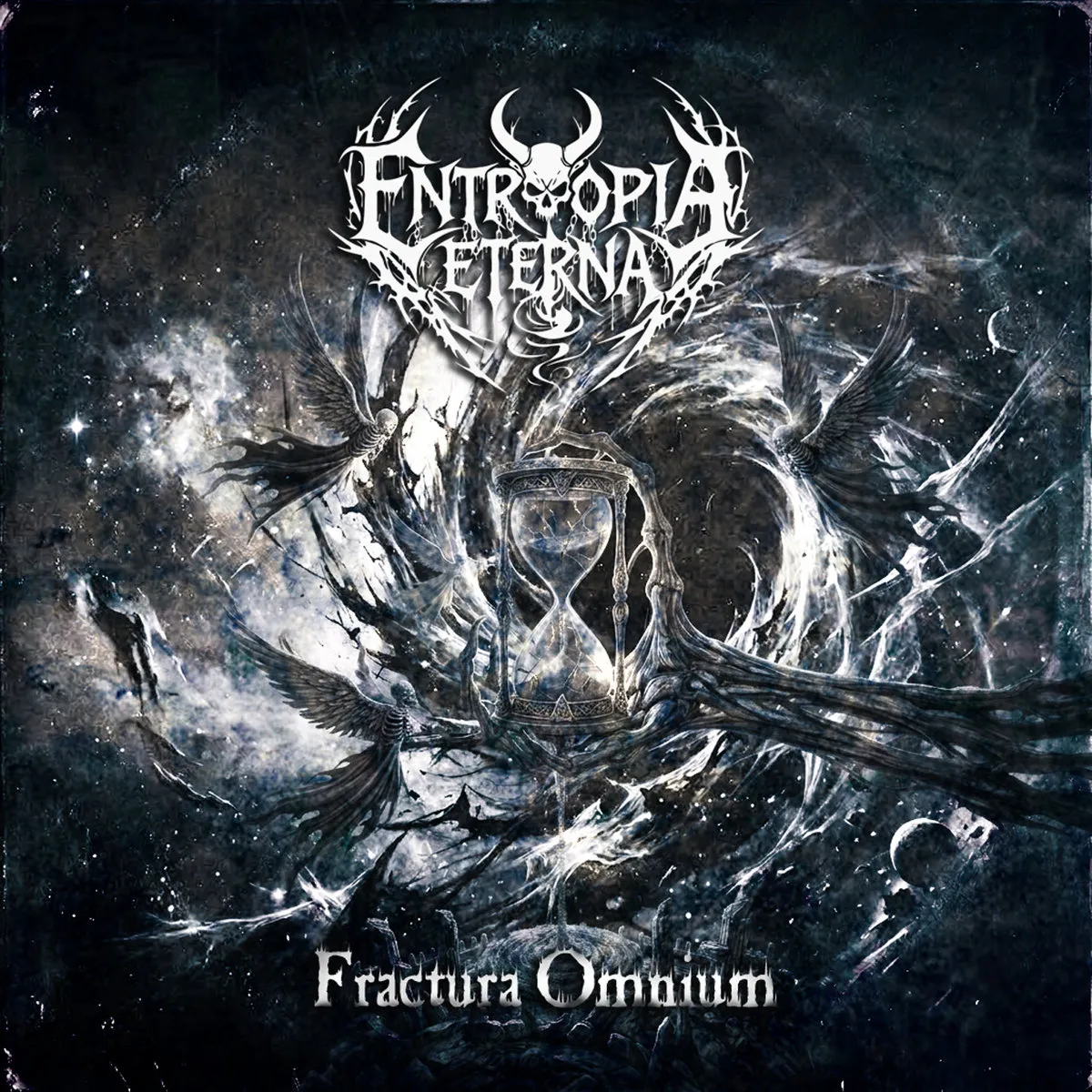
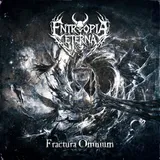
The sleeve is dense in the way this corner always is, an hourglass at the centre with winged skeletal figures around it against a nebula, and it tells you nothing the music does not already say. The Latin does more work than the painting.
Where it comes up short
Twenty eight minutes. That is a full length by the letter, and it is a short one by any standard, and it is short in the places that matter: the four middle tracks run between four and a half and five minutes each and share a tonal picture so close that the stretch between the opener and “Cosmic Funeral” blurs. The conceptual defence is that stasis is supposed to blur. The practical result is that a listener who does not have the track titles in front of them hears three songs that sound like one.
And the best idea on the record, the collapse into acoustic guitar and drone, gets two and a half minutes. The thing the whole album is building towards is the shortest thing on it.
So
Worth hearing, and worth hearing in order, which is not something I say often. The architecture is genuinely thought through and the ending earns the forty minutes of setup it does not quite get. The reservation is the middle: three tracks that hold the same shape is a defensible artistic choice and also a thin one, and the album would be stronger if the stasis section were shorter and the collapse at the end were longer. A very promising debut rather than a finished one.
The album’s stated arc shows up in the numbers without needing to be read into them. The five metal tracks sit in a tight, bright band, tonal centres between roughly 2.5 and 2.9 kilohertz with a fifth of their energy above five kilohertz, which is high for atmospheric black metal and gives the record its cold surface. Within that band the middle of the running order barely moves: “The Void’s Testament” and “Aeterna Dissolvunt” land within twenty hertz of each other on tonal centre and both stay inside roughly four decibels between their quietest and loudest passages, while the opener and “Cosmic Funeral” run three to four times that range. “Cosmic Funeral” is the widest and also the lowest-centred of the five. Then “The Heart Of The Void” leaves the scale entirely: its tonal centre drops to under a third of the album average, its energy above five kilohertz falls to almost nothing, more than forty percent of it sits below 250 hertz, and it runs some nine decibels quieter than the rest of the record. Nothing here is mastered flat, peaks keep a real distance from the average on every track.
Standout tracks: Cosmic Funeral, The Heart Of The Void, Seal Of Absolute Zero