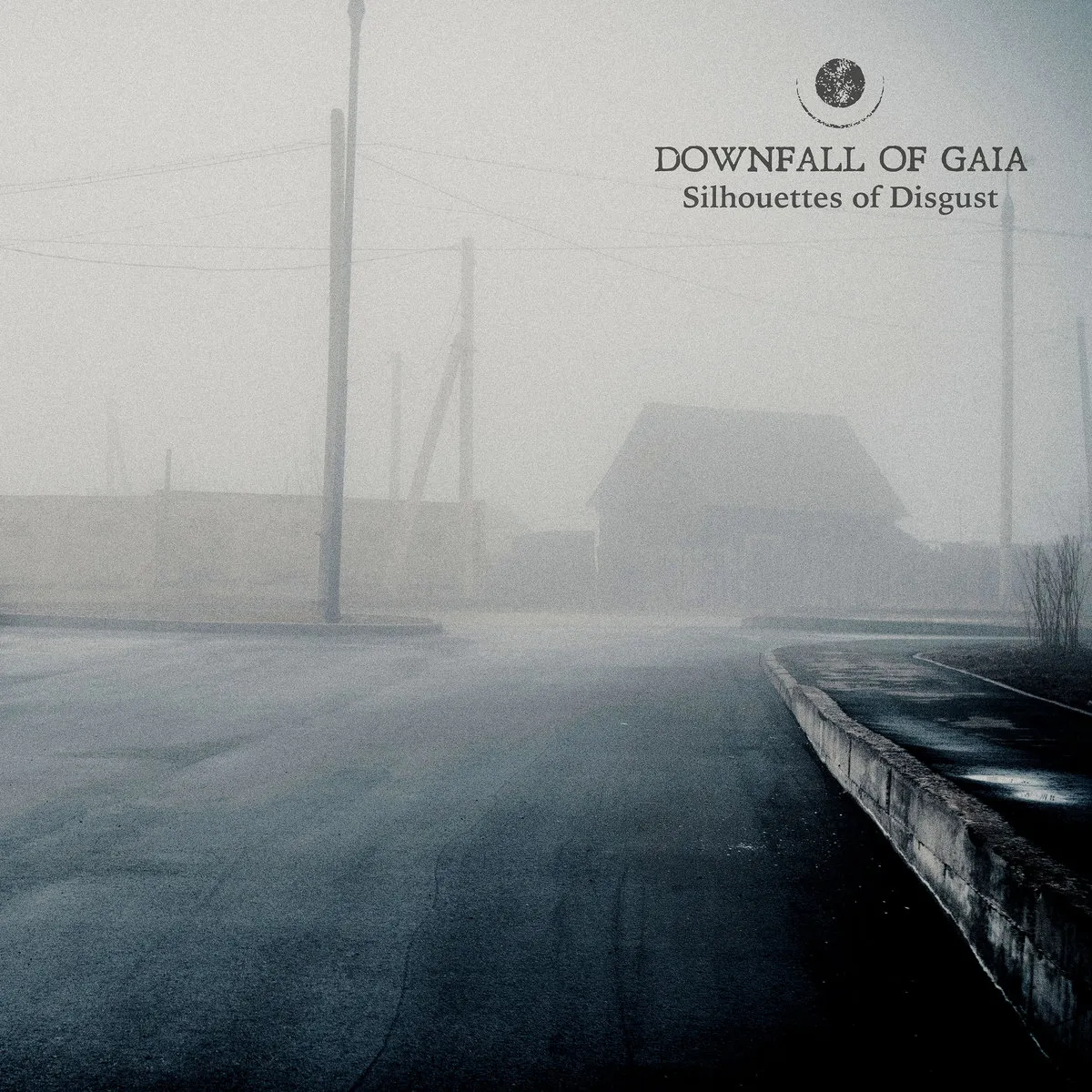
There’s a moment about thirty seconds into “Existence of Awe,” the opening track on Silhouettes of Disgust, where the drums drop into a locked, hammering groove and the guitars follow close behind, and something immediately feels different about this record. Downfall of Gaia have spent the last decade growing their songs longer, grander, more willing to take the scenic route. Here, they’ve reversed course. The song is tight, direct, and over in five and a half minutes. It announces an album that is, perhaps surprisingly, one of the most urgent things the band has made.
Silhouettes of Disgust is structured as a concept record, eight tracks for eight unnamed people living in a fictional city, each one carrying something that’s wearing them down. Loneliness, addiction, the kind of mental exhaustion that comes from being one person surrounded by millions who don’t see you. It’s a bleak premise, and the music doesn’t soften it. But Dominik Goncalves dos Reis, who handles vocals and guitar alongside returning co-founder Peter Wolff, has always been able to make bleakness sound full rather than empty, and that’s what saves the album from becoming an exercise in misery.
“The Whir of Flies” deals with the pull of addiction, the way a bad habit can feel like the only quiet room available, and does it without any kind of moralising. The song builds gradually, coiling tighter around a central riff before opening up near the end, and the restraint in how it’s put together makes it more affecting than a more dramatic approach would. Track three, “While Bloodsprings Become Rivers,” is the album’s longest at just over seven minutes and its most atmospheric, the kind of slow-moving piece the band made their name on. It earns its runtime.
“Bodies as Driftwood” is the centrepiece, and the record’s most striking detour. Lulu Black’s voice, usually heard in the industrial/gothic project This Is Oblivion, arrives quietly under the guitars, and the lyrics, unusually, are in German. It gives the track a different weight, something more private and more specific, like eavesdropping on a story not meant for you.
The second half of the album runs more or less on instinct. “Eyes to Burning Skies” is about the gap between how someone presents themselves and what they’re actually carrying; the song does something similar, starting controlled before pushing outward. “Final Vows” is the shortest thing here, lean and efficient, while “Unredeemable”, the album’s closing act before the title-referencing finale, is the track that most listeners seem to return to, a six-minute piece that moves through several distinct phases without ever feeling unfocused.
“Optograms of Disgust” closes the record and leans back into the crust-infused black metal that sits at the album’s foundation. It doesn’t resolve anything, which is probably the right call. These are stories without tidy endings.
The production is genuinely excellent, drums tracked in New Jersey with Kevin Antreassian, the rest built out in Hamburg, mixed by Timo Höcke at Die Wellenschmiede. The result is big without being overblown, and the synths the band introduced here for the first time add texture without calling too much attention to themselves.
Standout tracks: Bodies as Driftwood, Unredeemable, While Bloodsprings Become Rivers
Silhouettes of Disgust is Downfall of Gaia with something to say and the discipline to say it concisely. That’s harder than it sounds.


