 Bandcamp
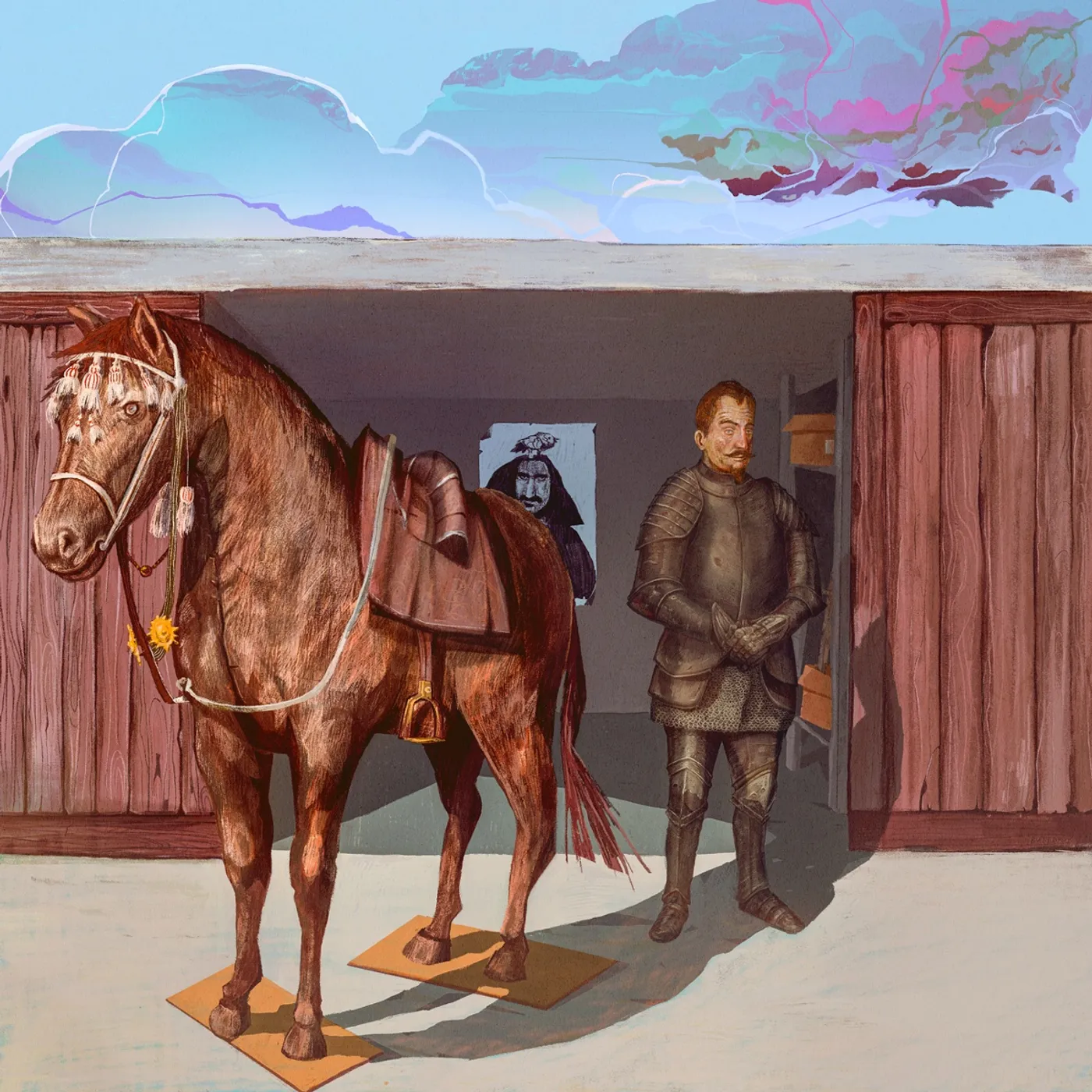
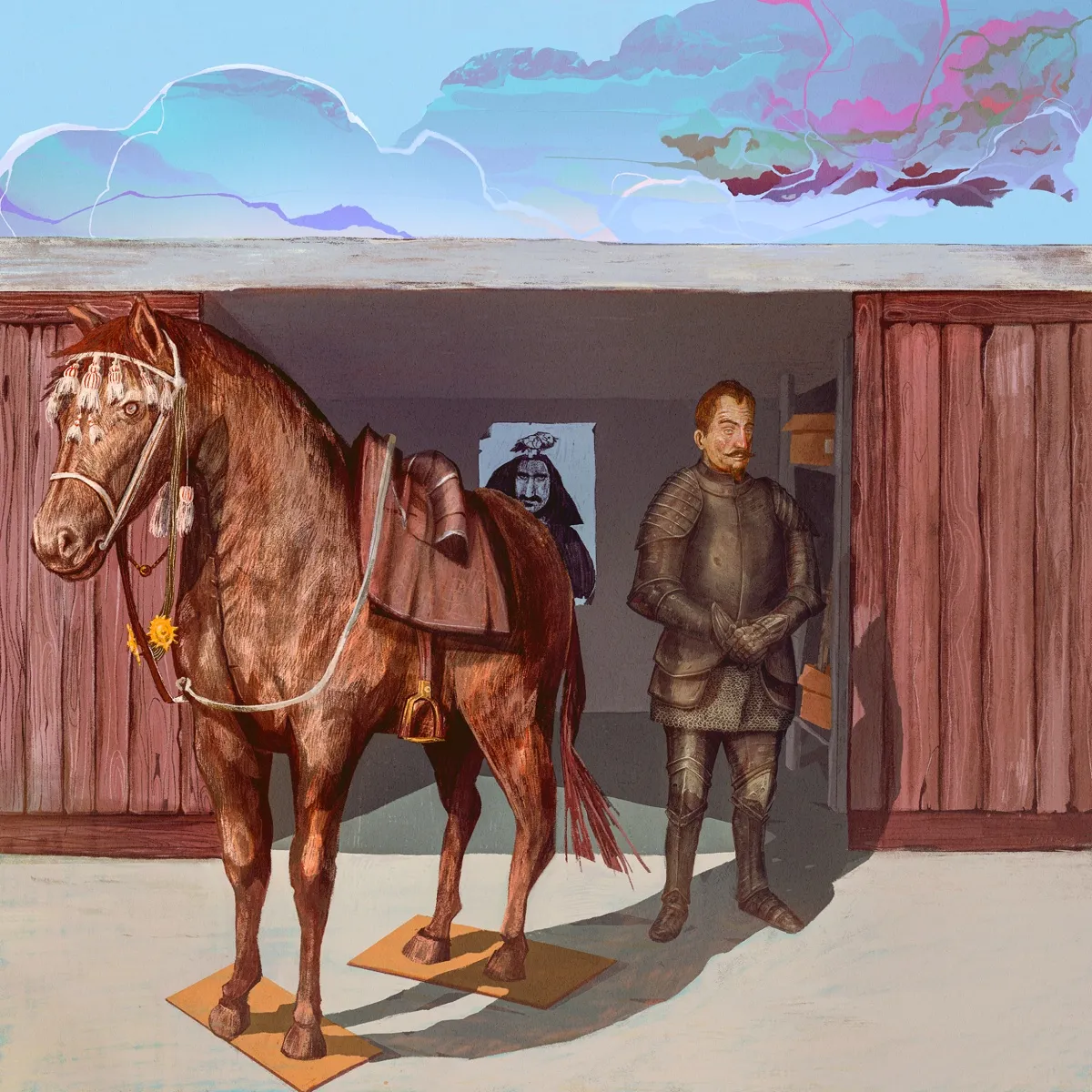
Albrecht von Wallenstein, the Bohemian general of the Thirty Years’ War, sits alone in a garage and works on his taxidermied war horse, Amore Mio, while he thinks back on the Battle of Lützen. That is the premise SEK built their debut album around, and the cover paints it plainly: a man in armour standing in the open door of a wooden shed, the horse in front of him standing on two flat boards, the sky above them in pink and turquoise. The label text calls the idea “deliberately absurd and surreal”. It is also the only place the story is told in words, because Wallensteins Garage has none. The Berlin trio play it entirely instrumental, and five titles have to carry the plot.
They do it well, mostly through order. The record opens in the garage, goes to Lützen in 1632, comes back to the horse, returns to the battle with “Auftritt zu Pappenheim”, named after the cavalry commander who rode into the battle at Lützen and was mortally wounded there, and closes with “Amore Mios Ende”. The horse frames the battle on both sides, which is a neat way of saying what the band are after: not the war itself but how it is remembered, by a man fiddling with a stuffed animal in a garage that has no business existing in his century. SEK take their name from the initials of their surnames, in the tradition of jazz ensembles, and the credits read Paul-Willy Stoyan on guitars, Georg Edert on drums and Lucas Kazzer on bass, with Benjamin Butter on keyboards and behind the artwork. Edert is also Elder’s drummer. After two DIY cassettes this is their first album on vinyl, out on Exile On Mainstream, five tracks in 41 minutes.
The shapes of the songs follow their titles closely enough to be fun to trace. The title track takes its time: it climbs for about three minutes before it reaches full strength, a slow start that suits a man picking up his tools. “Die Schlacht bei Lützen” does the opposite and starts at full force from the first second, the battle already under way, and holds there for more than six minutes before it pulls back for roughly a minute and then charges in again for the finish. “Auftritt zu Pappenheim” is the longest piece at over ten and a half minutes and the only one with a second keyboard player credited, Fabien de Menou, who also recorded, mixed and co-produced the album. After a short, quieter opening it is in the thick of things within half a minute.
The reservation is what happens once the songs arrive. In the title track, the battle song and “Auftritt zu Pappenheim”, the band reach their full level early and then stay within a couple of decibels of it for six to nine and a half minutes at a stretch. That is a long time to hold one intensity, and on an album with no voice to pull the ear through, the middle of these songs can blur into one wide, steady stream of riffs. The quiet and the build-ups live at the edges of the tracks, rarely inside them.
The closer shows what the record can do when it breaks that habit. “Amore Mios Ende” spends its first minute far below the rest of the album, quiet enough that it moves further between soft and loud than any other track here, by a wide margin. Then the full band crash in, and from about the four minute mark the song steps down to a lower level and holds there before it fades out. It is the horse’s ending and the album’s best idea in one: after thirty-five minutes of battle and restoration, the music simply lets the thing go.
Recommended to listeners who like their heavy psych long-form, wordless and with a concept they can read in the track list, and to anyone curious what Elder’s drummer does on his own time. Start with “Amore Mios Ende”, then go back to the garage and follow the order from the start.
The sound is warm and even across the album, with most of the energy in the middle range where the guitars and keyboards sit and a solid but unexaggerated low end. “Auftritt zu Pappenheim” carries the most bottom of the five and the brightest top, which fits its thicker arrangement. Four of the five tracks keep a moderate gap between their quiet and loud passages, mostly at their beginnings and ends, while “Amore Mios Ende” stands far apart with its very quiet opening minute. Nothing here is squashed for loudness: the peaks keep their room even in the heaviest stretches.