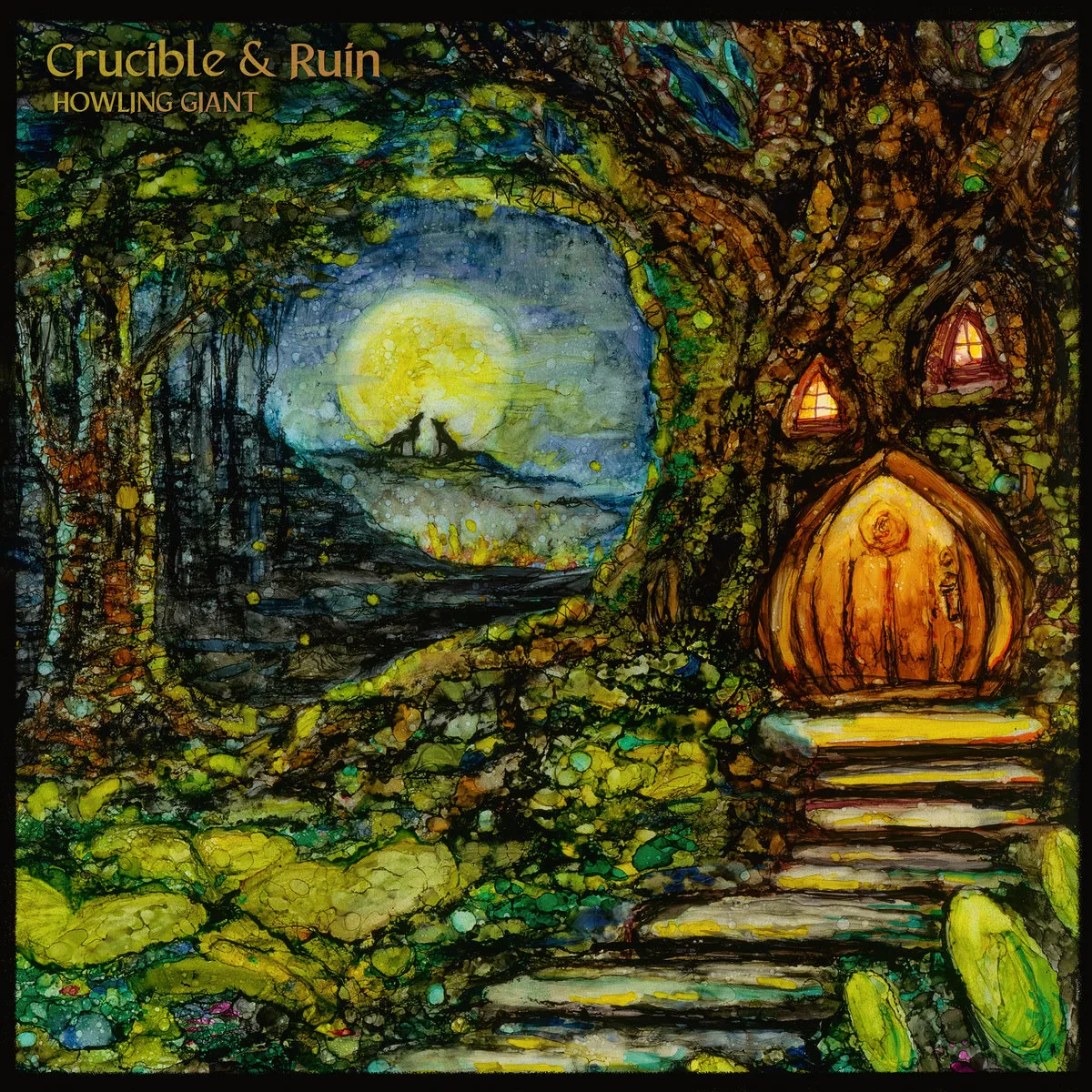
Howling Giant expanded their lineup for Crucible & Ruin, their third album, adding guitarist and synthesizer player Adrian Lee Zambrano to a core that was already firing on all cylinders. The Nashville quartet dropped the record on Halloween 2025 via Magnetic Eye Records, and the timing feels appropriate, this is music with an occult streak, a love of mythological weight, and the kind of riff density that suggests long hours in a practice space where the sun doesn’t reach.
“Canyons” opens things at a stately six-and-a-half minutes, establishing the album’s scale without rushing it. The guitar is heavy and deliberate, the vocal harmonies, always a Howling Giant strength, arriving with a kind of assurance that comes from a band who know exactly what they’re doing. The lyrics deal in geological time and collapse, civilizations leaving their mark in stone. It’s an opening that announces scope before momentum.
“Hunter’s Mark” tightens the frame, a four-and-a-half-minute track that moves faster, more predatory, the vocal hook circling something desperate. Then “Archon” pulls back to cosmic scale, six minutes of a god surveying the wreckage of countless worlds, the central riff cycling with a patient inevitability. The three-song opening stretch doesn’t waste a note.
“Lesser Gods” is a brief interlude at under three minutes, transitional but effective, and “Beholder I: Downfall” follows, the first of two tracks that share a mythology, built around a creature of endless eyes and ancient hunger. It’s the most aggressive thing on the record, the drums more prominent in the mix, the whole thing hitting harder than the run of songs before it.
“Archivist” is the album’s longest track and its best. Nearly seven minutes of a dispassionate cosmic observer recording the fates of worlds, the melody is one of the most affecting things the band has written, a vocal line that carries genuine melancholy inside the density of the instrumentation. The lyric’s final image, each opened scroll bringing another planet to life, lingers in a way that the more action-oriented tracks around it don’t quite match.
“Scepter and Scythe” and “Melchor’s Bones” carry the record through its penultimate stretch, the former a sharp four-and-a-half minutes about power and temptation, the latter more elegiac, a meditation on chosen ones and the cost of prophecy. “The Observatory” arrives as a sixty-seven-second instrumental interlude, synth-heavy and genuinely strange, before “Beholder II: Labyrinth” closes the record. It’s a different creature from its counterpart earlier in the album, slower, more resigned, the repeated refrain of “still world” becoming its own kind of incantation.
Neil Tuuri engineered and mixed the album at Amish Electric Chair Studios, and the production rewards the extra guitar. Zambrano’s synthesizers add texture without cluttering, they’re most audible on “The Observatory” and in the background of “Archon,” functioning as color rather than lead. Brad Boatright’s mastering at Audiosiege is characteristically clear-headed: the low end hits without obscuring, and the vocal harmonies, often three or four voices at once, stay distinct in even the densest passages. The decision to capture some performances as live-room takes pays off most noticeably on “Beholder I: Downfall,” where a looseness to the attack gives the song an urgency that a more assembled production might have ironed out.
Standout tracks: Archivist, Beholder I: Downfall, Canyons
Crucible & Ruin is a record that earns its mythology rather than borrowing it. Howling Giant have written an album with actual ideas inside it, specific, sustained, and consistently rewarding, and the expansion to a four-piece hasn’t diluted the sound so much as widened the sky above it.


