 Bandcamp
 The London Necropolis Railway opened in 1854 because the capital had run out of room for its dead. It ran from a private station beside Waterloo to Brookwood in Surrey, at the time the largest cemetery on earth, and it kept running for eighty-seven years until a bomb took the station out in 1941. It carried something over two hundred thousand coffins. It also sold tickets in classes, and the classes applied to the corpses as well as to the mourners, with Anglicans and Nonconformists riding in separate parts of the train.
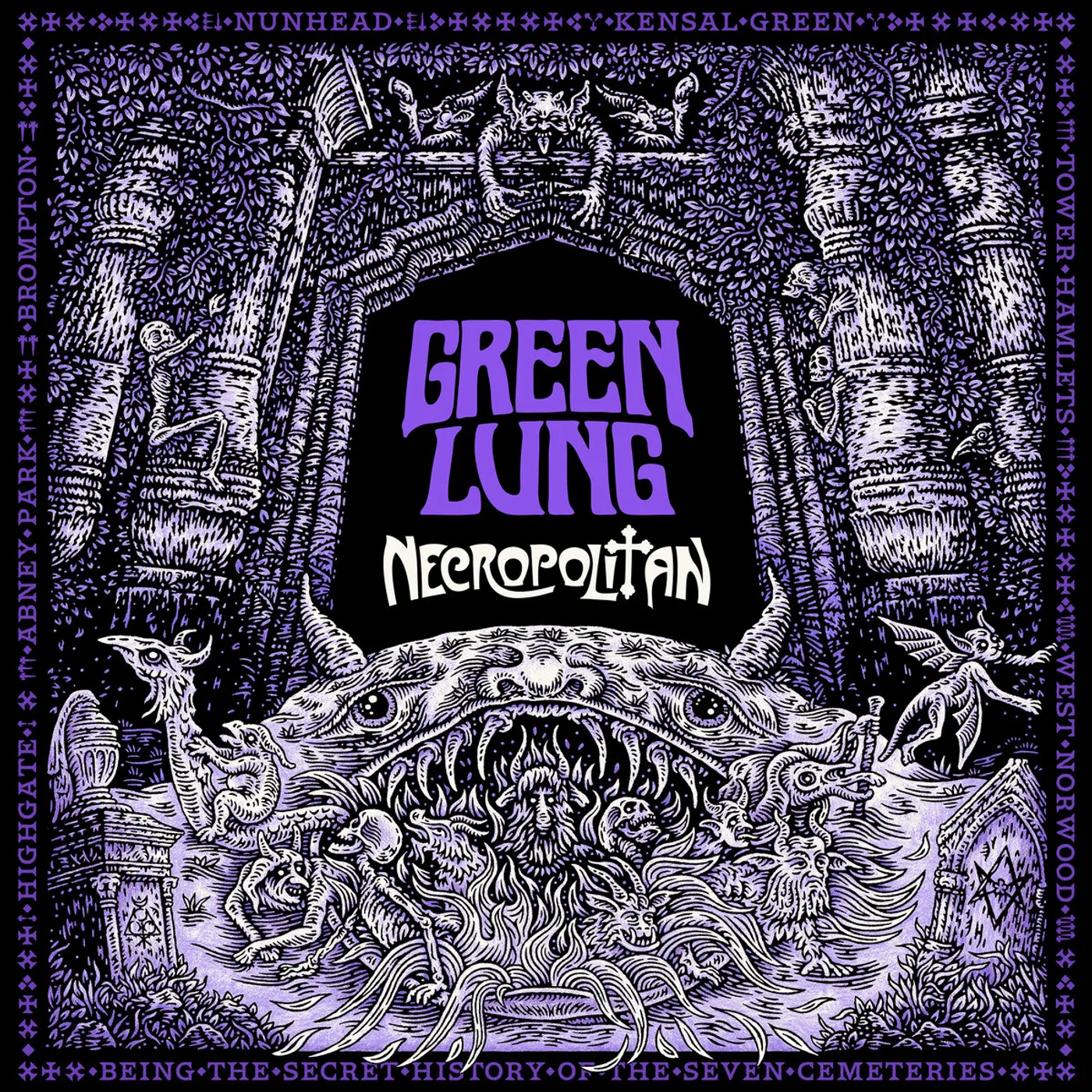
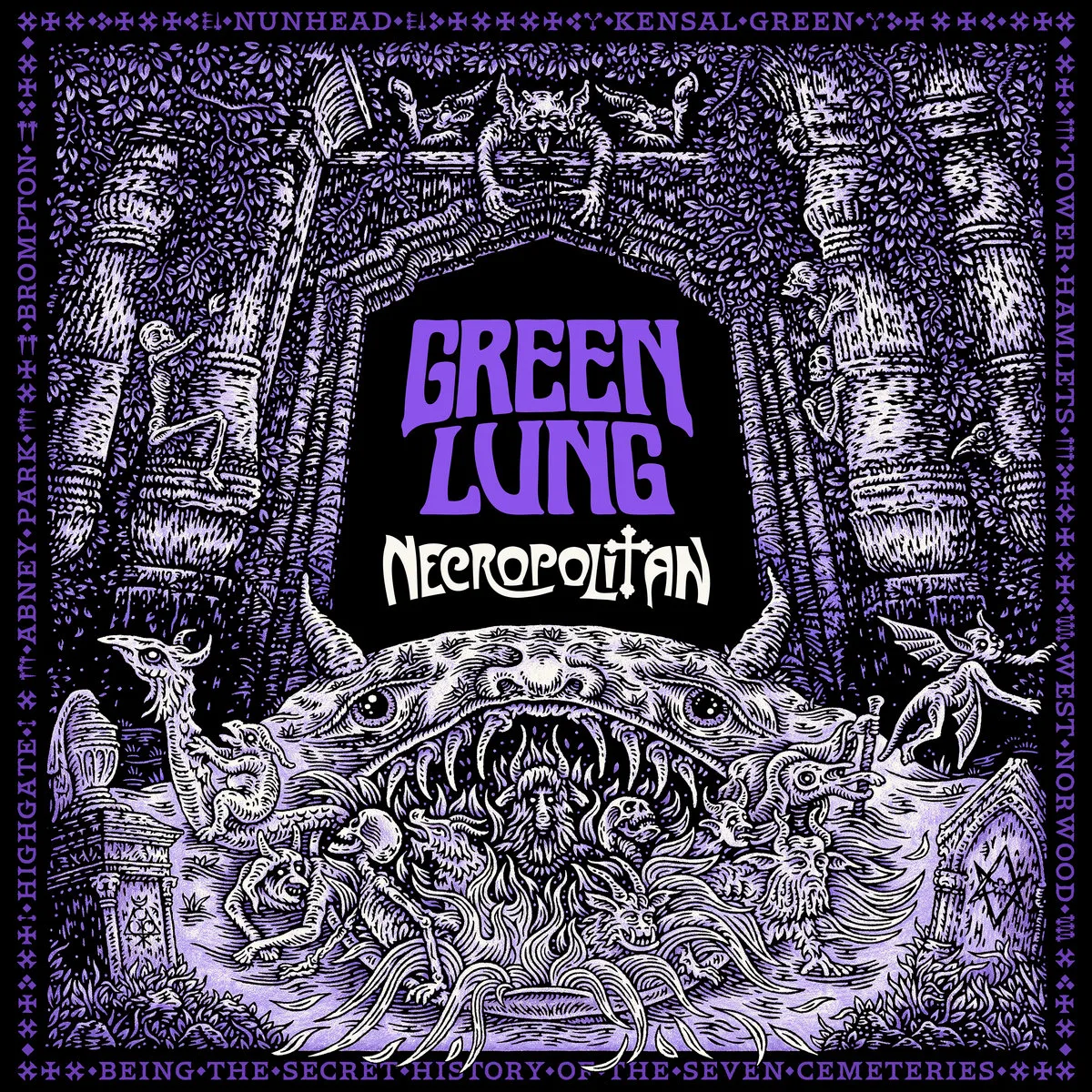
Richard Wells’ sleeve makes the frame explicit. Around the border it names seven London cemeteries, Nunhead, Kensal Green, Tower Hamlets, West Norwood, Highgate, Abney Park and Brompton, and along the bottom it reads: being the secret history of the seven cemeteries. Those seven are real and they are a set. Parliament passed a bill in 1832, a year after a cholera epidemic and with parish churchyards reusing graves within months, and within a decade London had seven enormous private cemeteries on its outskirts. Brookwood and its railway were the next answer to the same problem, twenty years later, when even those filled up.
Green Lung’s own bio describes the band as folklore, riffs and legends of Britain. On Necropolitan the legend has a timetable and a parliamentary record.
That distinction is the interesting thing about this record, and it holds across the tracklist rather than stopping at the title. “Ozymandias” is Shelley, a sonnet about an empire that left a broken statue and some bragging on a plinth. “Alostrael (Be My Babalon)” reaches for Leah Hirsig, who took that name when Crowley consecrated her as his Scarlet Woman in 1920, a documented woman rather than an invented sorceress. Even the ritual chanting is credited to five named people, Tracy, Luke, Lucy, Joe and Sasha, instead of being lifted from a library. This is a band whose occult furniture usually comes from a props department, deciding to go to the archive instead.
It changes what the songs can do. “Necropolitan Line” is the best thing here precisely because it does not editorialise: it moves at the speed of a train, the guitars bite in that specific British way that has not really changed since the early eighties, and the horror is entirely in the subject matter. When the record leans on real material it gets its authority for free. When it reaches for the standard occult register, as on “Evil in this House”, it is still very well made, but it sounds like a band doing a genre rather than telling you something.
Tom Dalgety recorded, mixed and produced it at Rockfield in January, and it sounds like exactly that: big, tight, treble-forward, absolutely under control. Tom K. Templar’s voice is the identity of the band and it is worth being precise about it, because it sits very high. What he does on “Evil in this House” is falsetto and head voice, executed with real accuracy and stacked into the choruses, and it is a man singing at the top of his range rather than the female lead a casual listen might suggest. The only woman on the record is Riley Pinkerton of Castle Rat, who narrates.
Two tracks break the polish, and they are the two worth returning to. “Black Magick Radio” is the one that actually sounds like the era it is quoting: Hammond organ wound through the guitar wall, a kit with genuine room around it, a kick that carries weight instead of a clicked edge, and a bass allowed to growl in the low middle rather than propping things up from underneath. “Together in Death” has the widest dynamic range on the album, opening on a dry, close acoustic guitar, gathering orchestral layers, and detonating just before the four minute mark.
Which is where the one real frustration sits. That detonation is the album’s biggest moment, and the master clamps down hard exactly as it lands, so the payoff arrives smaller than the four minutes of build deserved. It is the same story in miniature elsewhere: the low end is kept so disciplined that the bass spends most of the record as a floor rather than a voice, fully subsonic under “Alostrael”, and on “Ozymandias” the digital smoothness tips over into something a little airless, which is an odd fit for a song about ruins.
None of that stops it being the most confident record they have made. “To the Gallows Born” closes on a sacral baritone choir set against guitars that cut, and the gap between those two sounds is the whole album in one gesture: a very old country and a very modern studio, arguing.
Nine tracks, forty-one minutes, no filler, and a band big enough now to have done the easy version of this and demonstrably not bothered. Go and read about the railway afterwards. The record will send you there, which is more than most occult rock manages.
“To the Gallows Born” has the wiriest bass on the album, level and free of boom, and the twin leads stay separately locatable right through the densest passages, though the cymbals turn a shade sharp up top when everything is moving. “Dance to the Grave” sets the album’s default balance: treble-forward polish, a clicked kick for cut-through, and rhythm guitars compressed wide with the string separation holding. “Necropolitan Line” keeps its transients intact despite a loud master, with a metallic pick attack giving the bass a contour it lacks elsewhere. “Ozymandias” is the most polished and the most airless, the guitars precise to the point of sterility with synth lines sharing the midrange.
Standout tracks: Necropolitan Line, Black Magick Radio, Together in Death