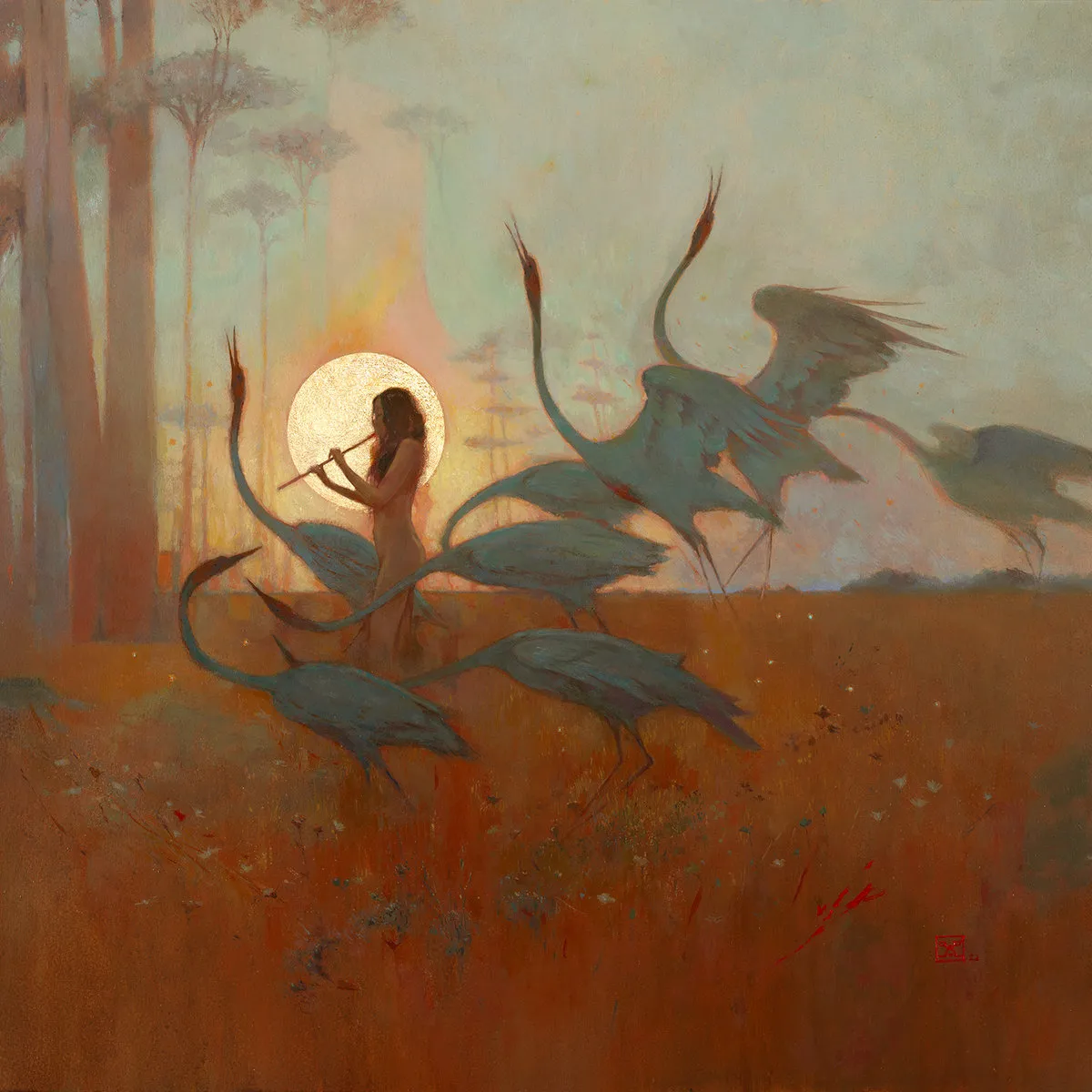
There is a Japanese word, komorebi, that describes the way sunlight filters through leaves, dappled, scattered, warm. It is not an accident that Neige chose it to open Alcest’s seventh album. Les Chants de l’Aurore (The Songs of Dawn) is an album about returning to the light, and “Komorebi” announces that intention before a single lyric lands. The guitars bloom out of near-silence, voices fold in like additional instruments, and the drums, Winterhalter’s drums, always a defining voice in this duo, settle into a driving pulse that carries the song forward without ever pushing it somewhere harsh. Six and a half minutes pass without effort.
The backstory matters here. Neige spent the early COVID years in a creative void, unable to write anything, afraid the music had simply gone. When it finally broke loose, it came out as “L’Envol”, the album’s lead single and its second track, and listening now you can hear why. It has the looseness of something written in relief. The guitars spiral around each other, the chorus opens wide, and at eight minutes it has room to breathe without needing to fill every second. It is not the most complex thing Alcest have written, but it might be the most generous.
“Améthyste” is the record’s centrepiece. It takes the longest to arrive at itself, nearly three minutes of haze before the full band comes in, but when the rhythm section locks and the guitars start weaving those bright, psychedelic lines, it becomes something genuinely difficult to leave. There is a riff buried in its second half that keeps surfacing just long enough to disappear again; the song is built around the pleasure of that anticipation.
“Flamme Jumelle” is shorter and more direct, a five-minute demonstration that Alcest can write pop songs if pop songs could float. “Réminiscence” is barely three minutes, an interlude that feels like a held breath between deeper dives. Then “L’Enfant de la Lune” arrives with its spoken Japanese and Haruna Nakaie’s viola da gamba threading through the guitars, making it the most quietly unusual thing on the record. It is also the most overtly beautiful, and it earns that.
The album closes with “L’Adieu”, lyrics borrowed from Guillaume Apollinaire, a poet who died in 1918 and wrote about love and loss with a simplicity that has aged better than most. Neige sets those words to music that feels as if it is dissolving as it plays, a deliberately gentle ending for an album that has spent forty minutes working toward something open.
Neige recorded and mixed Les Chants de l’Aurore himself, at home, and the decision shows, not in roughness but in intimacy. The guitars sit close and the reverb feels personal rather than architectural. Chris Edrich contributed additional mixing; Mika Jussila mastered. The result is warmer and less imposing than Spiritual Instinct, which suits the album’s intentions exactly.
Standout tracks: Améthyste, L’Envol, L’Enfant de la Lune


