 Bandcamp
 Picking up a story five years later
Most death metal concept albums are concepts in the way a film poster is a film. Wharflurch have been running theirs since 2021, when Psychedelic Realms ov Hell ended with its protagonist lost in a fungal haze and nothing resolved. This is the direct sequel, and the band have been specific about where it goes: the character is pulled out to the furthest regions of the universe, where the entities behind the mushrooms explain that seeding planets with their own spores to grow sentient life is not a local project but a standing arrangement across galaxies.
That is a properly silly premise delivered with a completely straight face, which is the correct way to do it. It also gives the record a shape that most cavernous death metal has to fake. There is a direction of travel here, and you can hear it in the numbers.
The record travels outward and downward
Seven of the eight tracks hold a consistent picture: mid heavy, with a fifth of the energy in the low end and somewhere between seventeen and twenty one percent above five kilohertz. Guitars and bass merge into a single saturated mass, the growls sit far back behind them and function as another layer of texture rather than as a voice out front, and several pieces open or close on ambient drift before the weight returns.
Then the closer. “Mycodeath and Rebirth / Awakening the Emissary” measures darker than everything before it by a wide margin, with its brightness collapsing by a third and the top end dropping to twelve percent. What is odd, and better than odd, is where the weight goes. The low end actually gets thinner on this track, down to the lowest figure on the album, while the low midrange swells to its highest. The finale does not end in sub bass, it ends in fog. For a record whose story is about being drawn away from a planet and into something vast and not quite comprehensible, a last track that trades bottom for haze is exactly right.
The other thing worth saying about the production: this has not been flattened. Across the album the peaks keep a wide distance from the average, the levels sit several decibels below where modern death metal is usually mastered, and the widest tracks, “Forgotten Temple” and “Revelation ov the SporeLords”, have real room to move inside them. In a genre that has spent fifteen years winning the loudness argument and losing the music, somebody here decided otherwise.
Where it gives ground
Eight tracks at a similar density is a lot to ask, and the middle of the record pays for it. “Headless God” and “The Heaving Orbs” occupy almost identical sonic territory and arrive back to back, and the album’s one structural idea, a quiet opening that gives way to blunt force, recurs often enough that by the sixth track you can feel it coming. The story moves. The arrangements do not always move with it.
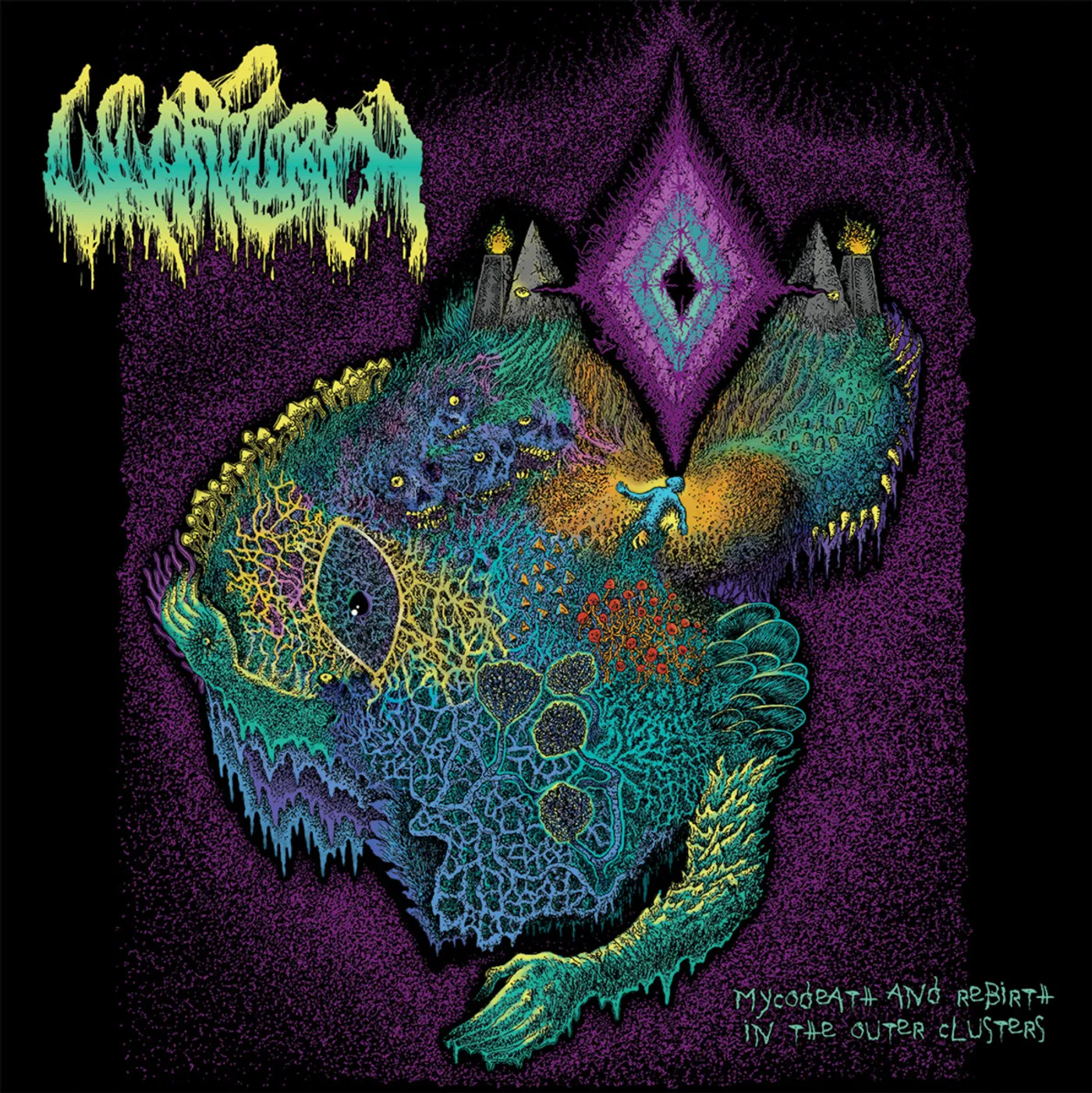
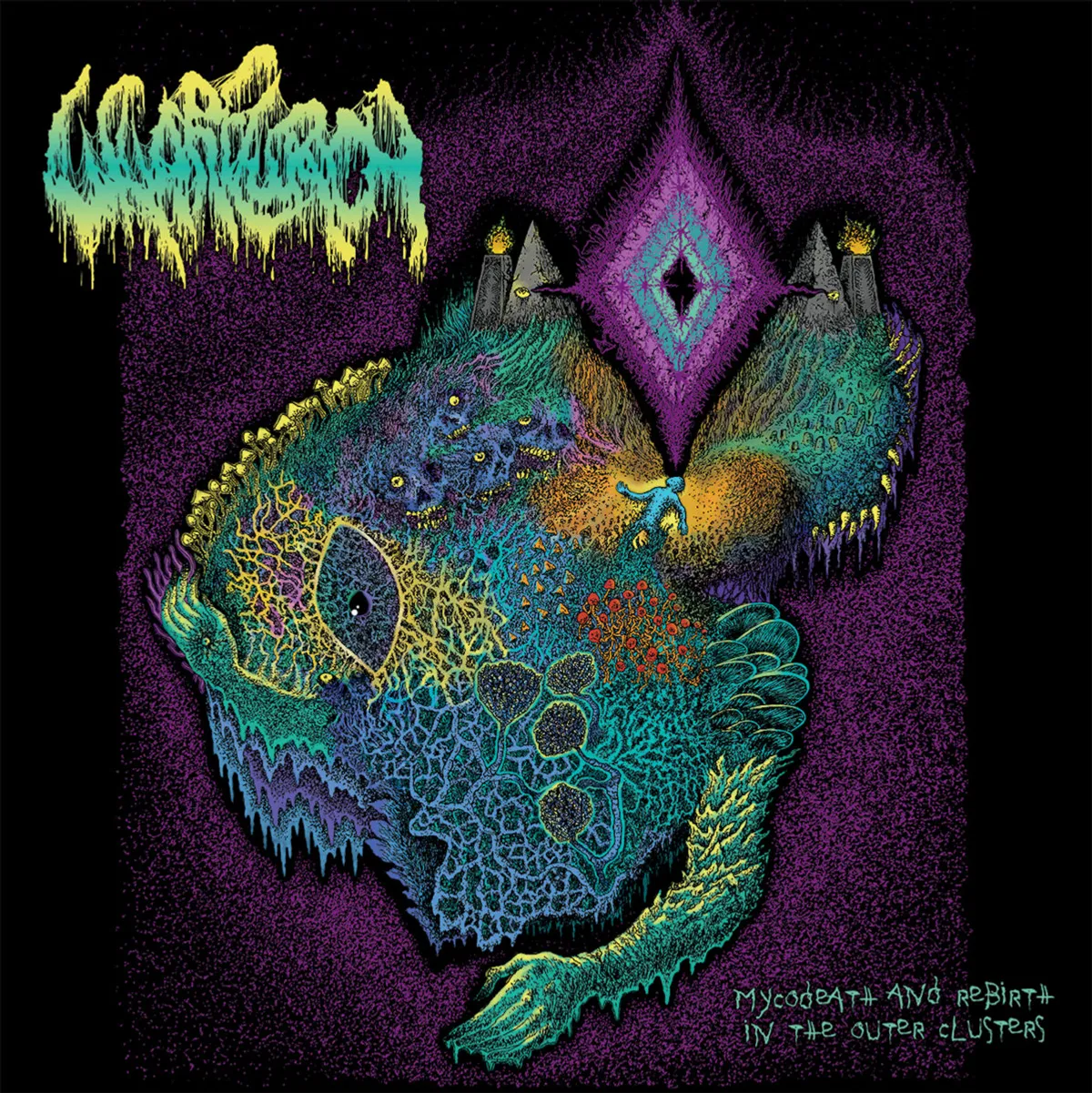
The sleeve, by Ian Collazo, is the best argument for the whole enterprise. A colossal creature lying on its side in teal and violet ink, its body grown over with mycelial webbing, caps and lattices until it reads as terrain rather than as an animal. Two pyramids burn on its flank, a diamond of light opens behind them, and a single tiny blue figure stands at the centre of it looking in. Everything the record is trying to say is in that one figure’s scale.
Five years is a long time to leave a character stranded. He is somewhere much stranger now, and the band have built the room for it.
The striking figure on this record is restraint. Its average level runs several decibels under where modern death metal normally lands, and the peaks stand well clear of that average on every single track, which is unusual enough in this genre to count as a statement. “Forgotten Temple” and “Revelation ov the SporeLords” open the widest gaps between their soft and loud passages; “Death Toll Horror” is the most tightly held and the least eventful by that measure. Seven of the eight pieces otherwise share a near identical spectral fingerprint. The finale departs from it on every axis at once: its centre of gravity drops by about a quarter, the treble falls away sharply, and the bottom end actually gives up ground to the low midrange rather than gaining it. The last track is not the heaviest. It is the least defined, and it is built that way.
Standout tracks: Mycodeath and Rebirth / Awakening the Emissary, Forgotten Temple, Revelation ov the SporeLords