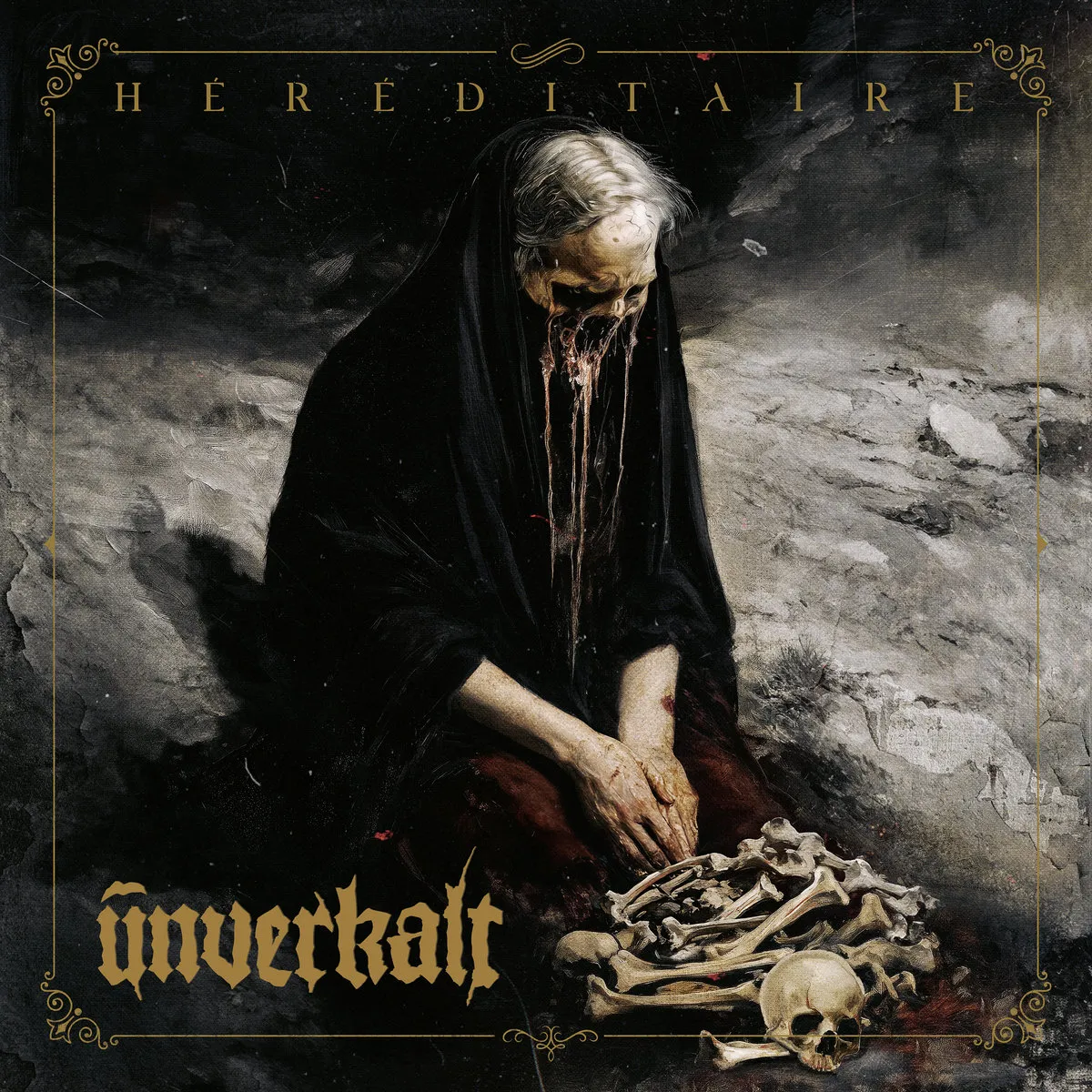
The title is French but the anger is universal. Héréditaire is an album about things passed down without consent: beliefs, guilt, patterns of destruction. “It’s all sorts of dead ideas / They cling to us all the same / And we can’t get rid of them,” Kalavrezou sings on “Introjects,” and that line could sit above the entire record as an epigraph. Unverkalt, a Greek band transplanted to Berlin and signed to Season of Mist, have spent two albums building toward this kind of directness. Their third record drops the cinematic distance of earlier work and replaces it with something blunter. The result is fifty minutes of post-metal that runs hot from the first track and never fully cools.
“Die Ausloeschung” sets the terms. The guitars hit with a rapid-fire distortion that builds into a wall of sound through sheer picking speed rather than layers of effects. The drums maintain a relentless pace north of 160 BPM, and during the blast beat sections, the kick drum pushes the low end into territory that feels physical. The lyrics open with loss: “Death filled this world / When did this darkness fall?” before spiralling into self-destruction and the wide gate that leads to ruin. For a band that draws comparisons to atmospheric and cinematic metal, there is nothing ambient about this opening.
The album’s emotional centre lives in the tension between its two vocalists. Dimitra Kalavrezou sits further back in the mix, her voice wrapped in reverb and delay, sometimes drifting into experimental territory that pushes against the song structures. Eli Mavrychev is more present, more direct, his delivery carrying the weight of the verses while Kalavrezou’s contributions haunt the edges. That dynamic gives Héréditaire a depth that a single-vocalist record could not achieve: one voice for confrontation, another for the unease underneath it.
Three songs carry lyrics in Greek, and these are among the record’s strongest moments. “Aenae Lithi” weaves Greek lines about searching in the shadows and drowning into its English framework, landing on “Psachno gia enan kosmo pou den yparchei” — searching for a world that does not exist. The mother tongue surfaces when the universal language is not enough, and the band knows when to let it through. “I, The Deceit” does the same, with Sakis Tolis of Rotting Christ joining Kalavrezou as the track builds toward its peak: “Kathe vima pou kanoume antichei sto keno / Se afti tin kataigida” — every step we take echoes in the void, in this storm. Tolis’s presence transforms the song into something monolithic, his voice adding the gravity of a career spent in exactly this territory.
“Introjects” gives the album its philosophical backbone. The concept of introjects — beliefs absorbed from others that feel like your own until you examine them — is not just a lyrical theme but a structural one. The song cycles through its central phrase with increasing urgency, “Break out” becoming less a suggestion and more a demand. “A Lullaby for the Descent” and “Penumbrian Lament” balance the aggression with vulnerability. “We are a blackened piece of art / Cold, dry, and pale / All colors are gone / How to put them back in place?” is the kind of writing that lands because the music around it has earned the emotional register.
Themis Ioannou composed the entire album and handles guitars and keys, which explains the compositional density. There is a lot happening in these nine tracks, but little of it feels excess. The shortest song runs under five minutes, the longest barely past six. For a post-metal record, that restraint is notable. No fifteen-minute builds, no ambient interludes. Every track has a purpose and exits when it is done. The closing “Maladie de l’Esprit” ends not with resolution but with a question repeated into silence: “Can we make it better?”
The mix is balanced and well-controlled. The wall-of-sound impression comes from the guitar attack, a fast, dense distortion that fills the mid-range through picking intensity rather than stacked effects. During blast beat passages, the kick drum drives the low end hard enough to shift the perceived balance toward the bass frequencies, but the overall spectrum stays even. Kalavrezou’s vocals sit further back with reverb and delay creating space around them, while Mavrychev’s are more present with a drier, closer placement, though both carry processing. The drums have a natural, room-driven quality with high onset density that gives the record its relentless forward motion. Cymbals are kept tight in the high frequencies. The loudness is pushed but leaves enough dynamic range for the quieter passages to function as genuine shifts in intensity rather than just volume drops.
Standout tracks: “Die Ausloeschung” for the opening statement and the speed at which it establishes what kind of record this is. “Introjects” for the thematic and musical peak, where the album’s central idea becomes a demand. “I, The Deceit” because Tolis and Kalavrezou singing in Greek over blast beats is a collision that justifies the entire feature.
Héréditaire lifts the veil, as the press copy puts it, but it also asks whether the veil was ever yours to wear. Unverkalt have made an album about inherited damage that sounds exactly like inherited damage feels: loud, inescapable, and older than you are.


