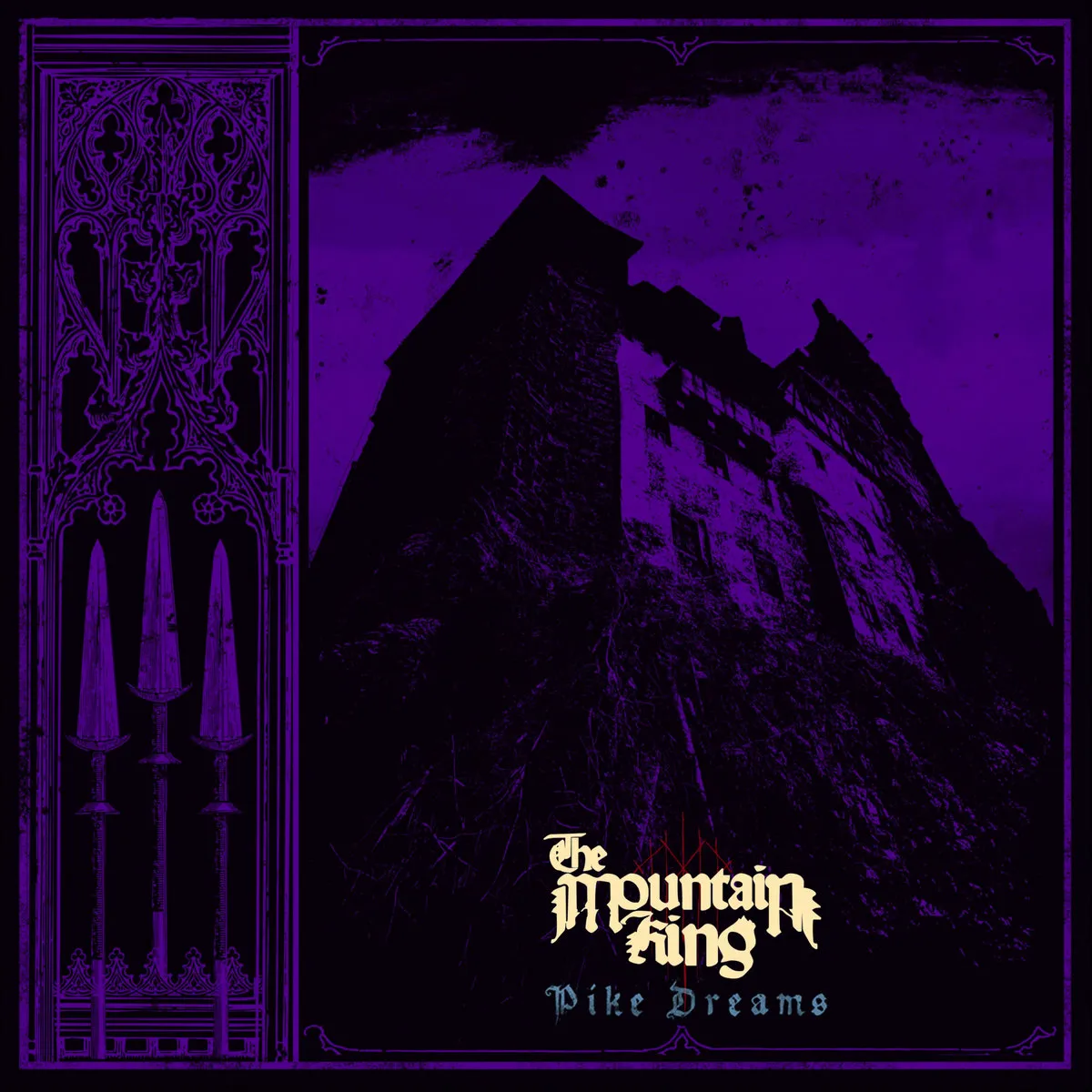
The Mountain King, the deliberately obscure project from Mainz, have an unusual structural conceit on Pike Dreams: each of the album’s eight tracks is named after a year. Not any year, but a hinge point, a moment where the trajectory of civilization shifted. The album asks you to sit with those moments and feel their weight rather than study them.
“476” opens with the fall of Rome. Not a single battle, but the final exhale of an empire that had held the Western world together for centuries. When the last emperor Romulus Augustulus was deposed by the Germanic warlord Odoacer, there was no dramatic collapse, just a quiet end to a system that had already been hollowing out for generations. Roads, aqueducts, legal systems, a shared language of power: all of it dissolving into something that would take centuries to replace. The track is slow, massive, built on low-end drones and synths that feel less like instruments and more like atmospheric pressure. Eric McQueen has sung on plenty of Mountain King records before, but Pike Dreams is entirely instrumental, not a single word across fifty minutes, and the silence where a voice would normally be is part of the point. History doesn’t narrate itself.
“1066” shifts into something heavier, more aggressive. The Norman Conquest: William of Normandy crossing the Channel, Harold Godwinson taking an arrow at Hastings, and an entire island’s language, law, and ruling class replaced in a single afternoon. English as we know it, the fusion of Germanic and French that shapes half the world’s communication today, begins here. Frank Grimbarth’s guitar work is dense and deliberate, the riffs carrying the kind of inevitability that doom metal does at its best. “1328” pulls back into fragile synth textures. Europe in the wake of the Great Famine, a catastrophe that killed millions between 1315 and 1322 and left entire regions depopulated. The feudal order that had held the continent together was cracking under its own weight. Two decades later, the Black Death would finish what the famine started.
“1381” is the English Peasants’ Revolt, and the track matches it: the most dynamic piece on the record, tension building through layered instrumentation until it reaches a breaking point that feels earned. The revolt was the first major uprising of working people in English history. Decades of plague had decimated the labor force, and the surviving peasants suddenly had leverage they’d never known. When the crown responded with a poll tax designed to squeeze the people who had the least, tens of thousands marched on London under Wat Tyler and the radical preacher John Ball, whose famous question still resonates: “When Adam delved and Eve span, who was then the gentleman?” They burned the Savoy Palace, opened the prisons, and for a brief moment held the future in their hands. The king made promises. Then he broke them.
“1524” follows with the German Peasants’ War, the largest popular uprising in European history before the French Revolution. Thomas Müntzer, a theologian from Thuringia who had broken with Luther over the question of whether the Reformation should serve the powerful or the powerless, became its voice. Müntzer argued that the Word of God demanded not just spiritual freedom but material justice: an end to serfdom, common access to forests and waterways, the right to choose your own pastor. Over 300,000 peasants rose across what is now southern Germany, Austria, and Switzerland. They were slaughtered. Müntzer was captured, tortured, and beheaded. Luther sided with the princes. For a band from Mainz, the city where Gutenberg’s press helped ignite the Reformation that Müntzer tried to radicalize, this isn’t abstract history. It’s local. The track is slow and grinding, the guitars and synths merging into something that sounds like inevitability.
“1789” needs no footnote. The French Revolution, the old world burning. The storming of the Bastille, the Declaration of the Rights of Man, the Terror that followed: the moment where Europe’s feudal order finally collapsed under the weight of its own contradictions. Eric McQueen’s programmed drums push this track into territory that borders on post-metal, the rhythm carrying a forward momentum that the earlier tracks deliberately avoided. It’s the moment on the record where history stops being cyclical and starts feeling directional. It’s also where the production issues become hardest to ignore: the programmed beats sit on top of the mix rather than inside it, and the low end competes with itself rather than reinforcing the weight the track is reaching for.
“2010” brings us close to the present, and the year hits differently than the others. The Arab Spring: Mohamed Bouazizi, a Tunisian street vendor, set himself on fire in December after police confiscated his cart. Within weeks, protests spread across Tunisia, Egypt, Libya, Syria, Bahrain, Yemen. Millions of people demanding dignity, representation, an end to decades of authoritarian rule. What makes 2010 unique in this album’s arc of upheaval is the infrastructure of resistance. When the Mubarak regime shut down Egypt’s internet to silence the protests, hackers and activists around the world responded. Engineers at Google and Twitter built speak-to-tweet services. The Telecomix collective, a decentralized network of tech activists, set up dial-up modem banks and fax-to-internet bridges so Egyptians could get information in and out. People configured VPN tunnels from their living rooms in Berlin and Stockholm to give strangers in Cairo a connection to the outside world. It was messy, improvised, sometimes futile, but it was solidarity built from code and hardware, and it mattered. The track is the album’s most ambient stretch, synths and programming creating a landscape that feels both familiar and uneasy. As someone who lives in that intersection of technology and conviction, this is the track that stays with me longest. And then “2026,” a two-minute bonus track that lands in the present tense. It’s a fragment, unresolved, the kind of ending that refuses to provide closure because the story isn’t finished.
The production is the album’s biggest problem. The low end is muddy and poorly separated, guitars and synths fighting for the same frequencies rather than complementing each other. The drums are programmed and sound like it: mechanical, lacking the dynamics and imperfections that give real percussion its sense of gravity. In the quieter, ambient-leaning passages this matters less, but whenever the full instrumentation kicks in, the mix turns congested. A concept this ambitious deserves a production that can carry its weight, and Pike Dreams doesn’t quite get there. The mastering compounds the issue by compressing the dynamic range that the songwriting is clearly reaching for.
Standout tracks: 1381, 1789, 476
Pike Dreams has one of the strongest concepts a doom record has carried in years, and the songwriting often rises to meet it. But the execution falls short. Programmed drums that never convince, a muddy frequency spectrum, and a mix that can’t support the ambition of the material: these aren’t minor complaints when the entire album depends on atmosphere and weight. The Mountain King clearly have the ideas. Next time they need a production that does them justice.


