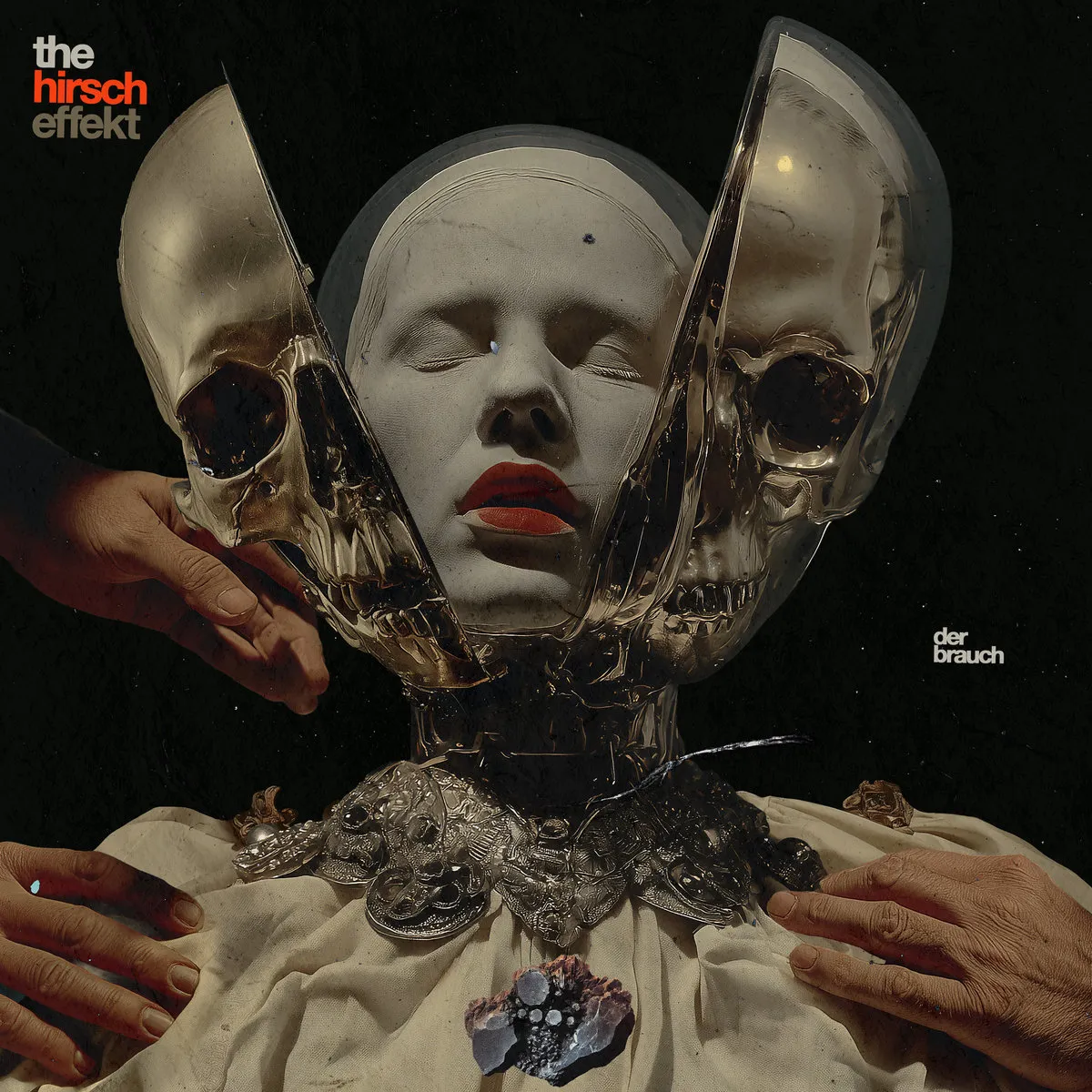
The Hirsch Effekt have never been easy to place. The Hannover trio, Nils Wittrock on guitar and vocals, Ilja John Lappin on bass and cello, Moritz Schmidt on drums, have spent fifteen years making music that lands somewhere between the precision of progressive metal and the emotional directness of post-hardcore, without quite belonging to either. Their seventh album, Der Brauch, doesn’t resolve that tension. It deepens it, deliberately, and the result is the most architecturally ambitious record they’ve made.
The title translates roughly as “the custom” or “the ritual,” and the album earns that framing. Each of the nine tracks carries a German title, Der Faden (the thread), Das Seil (the rope), Die Brücke (the bridge), Die Heimkehr (the homecoming), and the sequence reads like a journey that is never quite explained. That’s a strength here, not an evasion. The album lets the music carry the meaning, and the music is dense enough to hold it.
The opening title track sets the terms immediately. Five and a half minutes of knotted guitar lines and coiled rhythms that keep promising to break open and don’t, not fully, until the final seconds. It’s a patience test and a scene-setter. “Der Faden” follows at roughly the same length and is a shade warmer, a melody emerges in the second half that’s almost pop in its clarity, which makes the surrounding noise feel more considered rather than less.
“Das Seil” is the centrepiece at seven and a half minutes, and it’s the track that justifies the album’s ambitions most completely. Lappin’s cello enters partway through and doesn’t function as decoration, it pulls the song’s centre of gravity somewhere quieter and stranger, the metal receding without disappearing. When the full band returns, it’s with more weight than before. The reprise that follows (“Brauch Reprise,” under two minutes) acts as a reset, a breath before the album’s second half.
“Der Doppelgänger” and “Die Lüge” are the heaviest stretch of the record, Schmidt’s drumming moving with a directness that some of the earlier tracks deliberately avoid. “Die Lüge” at nearly eight minutes is the longest track and the one that most clearly reaches for something cinematic, it moves through four or five distinct moods without losing thread, which is no small achievement. “Die Brücke” pulls back, leaner and more direct, before “Das Nachsehen” and “Die Heimkehr” bring the record home across a combined eleven minutes.
The closing pair work as a unit. “Das Nachsehen” holds a grief in it that’s hard to name precisely, Wittrock’s vocals at their most exposed, the guitar spare around them, and “Die Heimkehr” resolves the album in the only way that would work: not with a cathartic climax but with something gentler, a kind of arrival rather than a finish.
The production keeps everything at close quarters without crowding the detail. Lappin’s bass is a constant lead presence rather than a supporting structure, and that choice shapes the album’s character throughout. This is a record that rewards repeated listening not because it’s complex for its own sake, but because the threads it sets up in the opening minutes take most of the runtime to fully resolve.
Standout tracks: Das Seil, Die Lüge, Die Heimkehr


