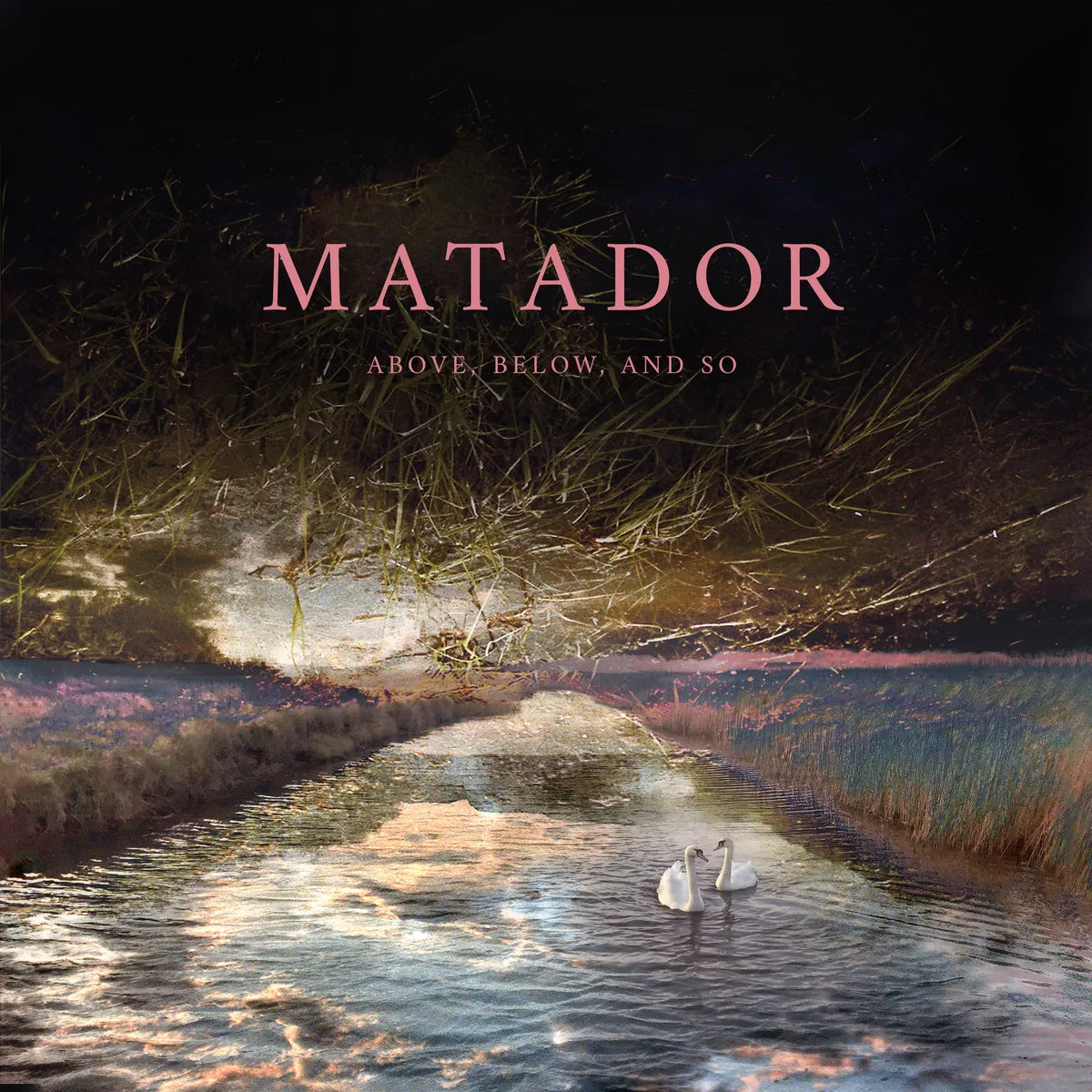
Three people made this record. That fact is worth stating upfront because nothing about Above, Below and So sounds like a power trio. The sheer mass of it, the way it fills a room, the layered guitars that seem to come from everywhere at once, all of it points to a band twice this size. But Matador are James Kirk on guitar and vocals, Mark Ainsworth on bass, and Scott Stronach on drums, and whatever they’re doing to make this sound the way it does, it works.
“The House Always Wins” opens the album with a slow, deliberate build. The riff arrives around the two-minute mark and just sits there, grinding, immovable. Kirk’s guitar tone is enormous, thick and warm without losing definition, the kind of sound you feel in your chest before you hear it in your ears. The title nods to a dedication: the album is for Chris “La Maison” Leggett, and there’s something fitting about opening a record about birth, life, and death with a track that sounds like the foundations of something permanent being laid down.
“Glitter Skin” picks up the pace without losing the weight. Stronach’s drumming is the key here, driving the song forward with a physicality that keeps the heaviness from becoming static. There’s a groove to it, a forward motion that gets your head moving before you notice. Ainsworth’s bass locks in underneath, and the two of them create a rhythm section that gives Kirk’s guitar all the space it needs to do damage.
“The Flood” introduces Karen Wallace’s guest vocals and words written by Jayne Kirk. The song shifts between crushing and fragile, Wallace’s voice cutting through the distortion like a different frequency entirely. It’s the most dynamic track on the record, moving through passages that swing from near-silence to full devastation within a single breath.
“O Suna” is a two-and-a-half-minute interlude, quiet and sparse, the only moment on the album where the band lets go of volume entirely. It works because of what surrounds it. Coming after “The Flood” and before “A Virus”, it functions as a reset, a pause before the album’s heaviest stretch.
“A Virus” is the longest track at ten minutes and the album’s peak. The riff that anchors the first half is massive, slow-moving and relentless, and when it finally breaks open around the six-minute mark the release is physical. This is the song where you catch yourself nodding along without realizing you started. The production, handled by Kirk himself and mastered by Neil Pickles, gives every element room to breathe even at maximum volume.
“Hooks” closes the record with the closest thing to a straightforward song structure here. It builds, it peaks, it resolves. But even in its most conventional moments, the tone and the weight keep it rooted in something heavier than the sum of its parts.
Kirk mixed and produced the album himself, and the result is one of the fattest guitar sounds we’ve had on this site. The low end is thick but never muddy, with Ainsworth’s bass occupying its own space below the guitar rather than competing with it. Stronach’s drums were recorded at Head Gap Studios by Finn Keane (with “Glitter Skin” tracked by Jim Rindfleish), and they have a natural, room-filling quality. The mastering by Neil Pickles keeps the dynamic range intact, which is crucial for music that relies on the contrast between quiet passages and full-bore heaviness. Wallace’s guest vocals on “The Flood” are mixed with restraint, present but never pushed forward artificially.
Standout tracks: The House Always Wins, A Virus, The Flood
Above, Below and So is music about birth, life, and death, and it sounds like all three at once. Matador have made a record where the weight never lets up but never becomes exhausting, where three musicians generate more force than most bands manage with twice the personnel. Church Road Records continues to find bands that deserve to be louder than they are. This is 41 minutes that demand to be played at volume, and they earn every decibel.


