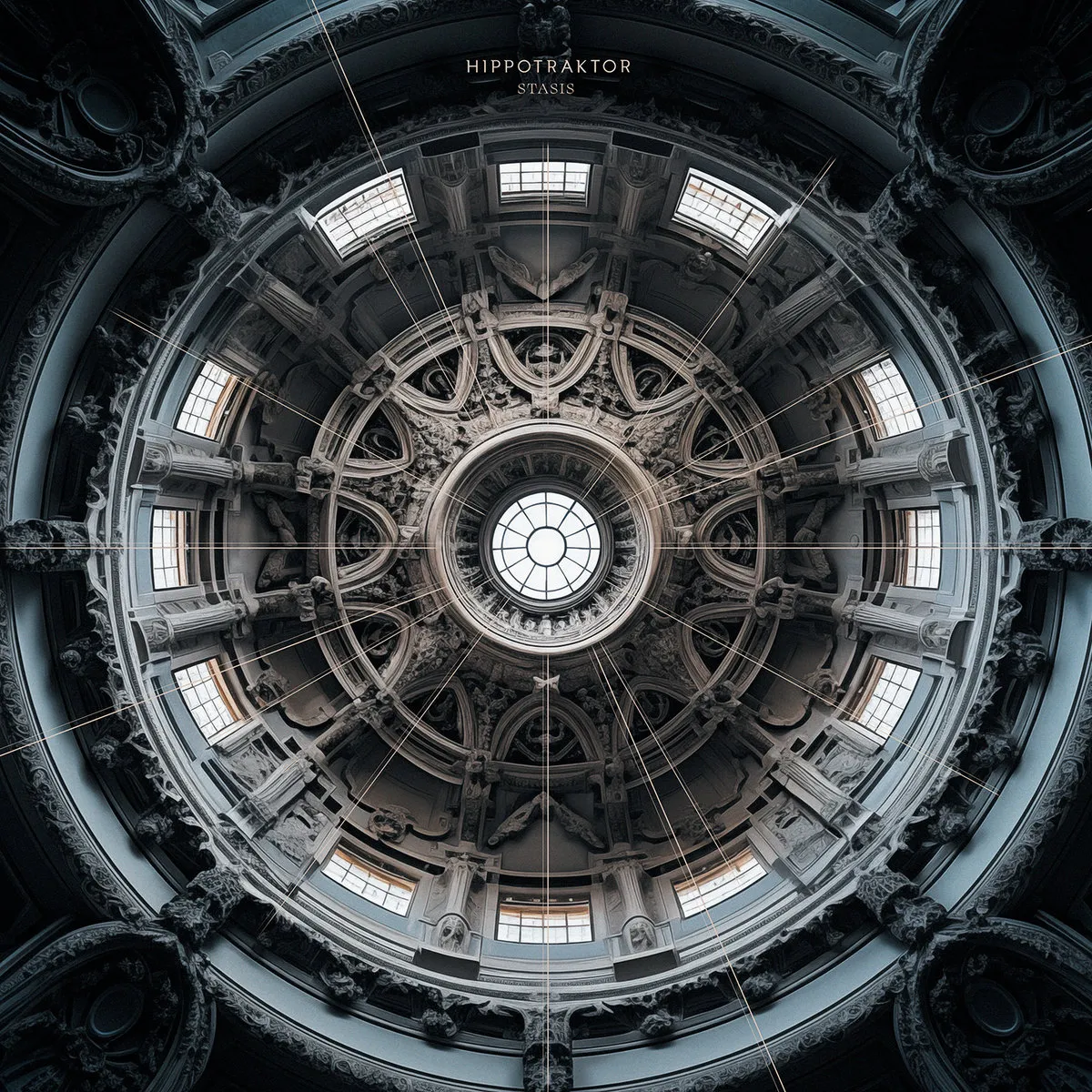
Stasis opens with a drop. Not a riff exactly, not a song as such, just a few suspended beats and then everything arriving at once: a wall of guitar and voice that immediately announces this is going to be a different kind of record. For a band that spent its early years as an instrumental trio, Hippotraktor has become something considerably more complicated, a five-piece from Mechelen, Belgium, that now navigates both the physical weight of post-metal and the storytelling ambitions of prog with equal conviction.
The album tells a single story. Stefan De Graef, who joined as vocalist alongside guitarist Sander Rom in 2021, wrote the narrative thread that runs through all seven tracks: a protagonist encountering the wider world for the first time, discovering generosity and greed in roughly equal measure, and looking back on it all with something between grief and understanding. It’s a framework ambitious enough to collapse under its own weight, and Stasis occasionally tests the limits, but it holds.
“Descent,” the opening track at nearly seven minutes, earns its name. It doesn’t ease you in. Chiaran Verheyden’s guitar work is dense and patient, locking into a pattern before splitting into something else entirely. By the time the second chorus arrives, the track has moved through three or four distinct moods without losing the thread. “Echoes” brings the tempo down slightly, something closer to meditation, before the album’s best-known song, “Silver Tongue,” cuts through with a clarity the earlier tracks deliberately withhold. It’s the sharpest thing here, a four-and-a-half-minute demonstration that the band can write a hook without abandoning the complexity that distinguishes them. The harmonies arrive early and linger; the breakdown that follows hits harder for it.
“Renegade” and “The Indifferent Human Eye” form the album’s dense centre, both running past seven minutes. This is where the polyrhythmic sections earn their keep: the figures in “Renegade” are machine-precise, but they don’t feel mechanical, they feel coiled, like patience being tested. De Graef’s vocals here are at their most confrontational, matching the rhythm section’s aggression with a delivery that never loses its shape. Jakob Fiszer’s bass is quietly crucial throughout, sitting forward enough in the mix to give even the busiest passages a low centre of gravity.
The title track, sixth of seven, is the album’s emotional climax. Where the earlier songs have been outward-facing, the protagonist reading the world, reacting to it, “Stasis” turns inward. The dynamics shift, the guitars find a melodic centre they’ve been orbiting for forty-odd minutes, and the result is the one moment on the record that could reasonably be called beautiful. “The Reckoning” closes things with something like resignation: the protagonist has seen what he’s seen, and there’s no revision available.
Verheyden produced, recorded, and mixed the record himself, and it sounds exactly as physical as it should. The low end is present without becoming oppressive; the vocals are mixed forward enough to carry the narrative weight without crowding the instruments. It’s a record that rewards a complete listen, the individual songs are strong, but the architecture is the point.
Standout tracks: Silver Tongue, Renegade, Stasis
Hippotraktor’s sophomore record doesn’t stagnate. It builds something.


