 Bandcamp
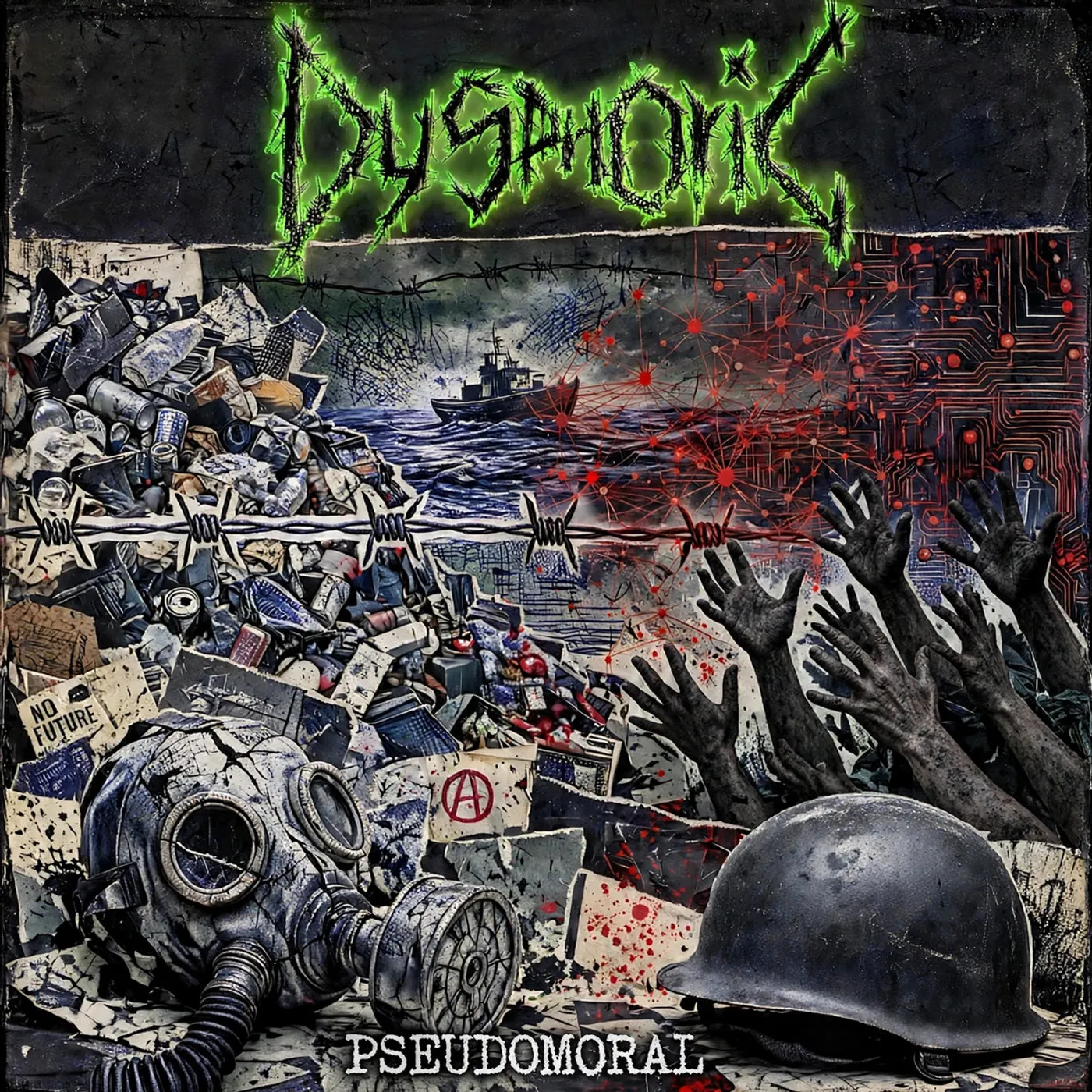
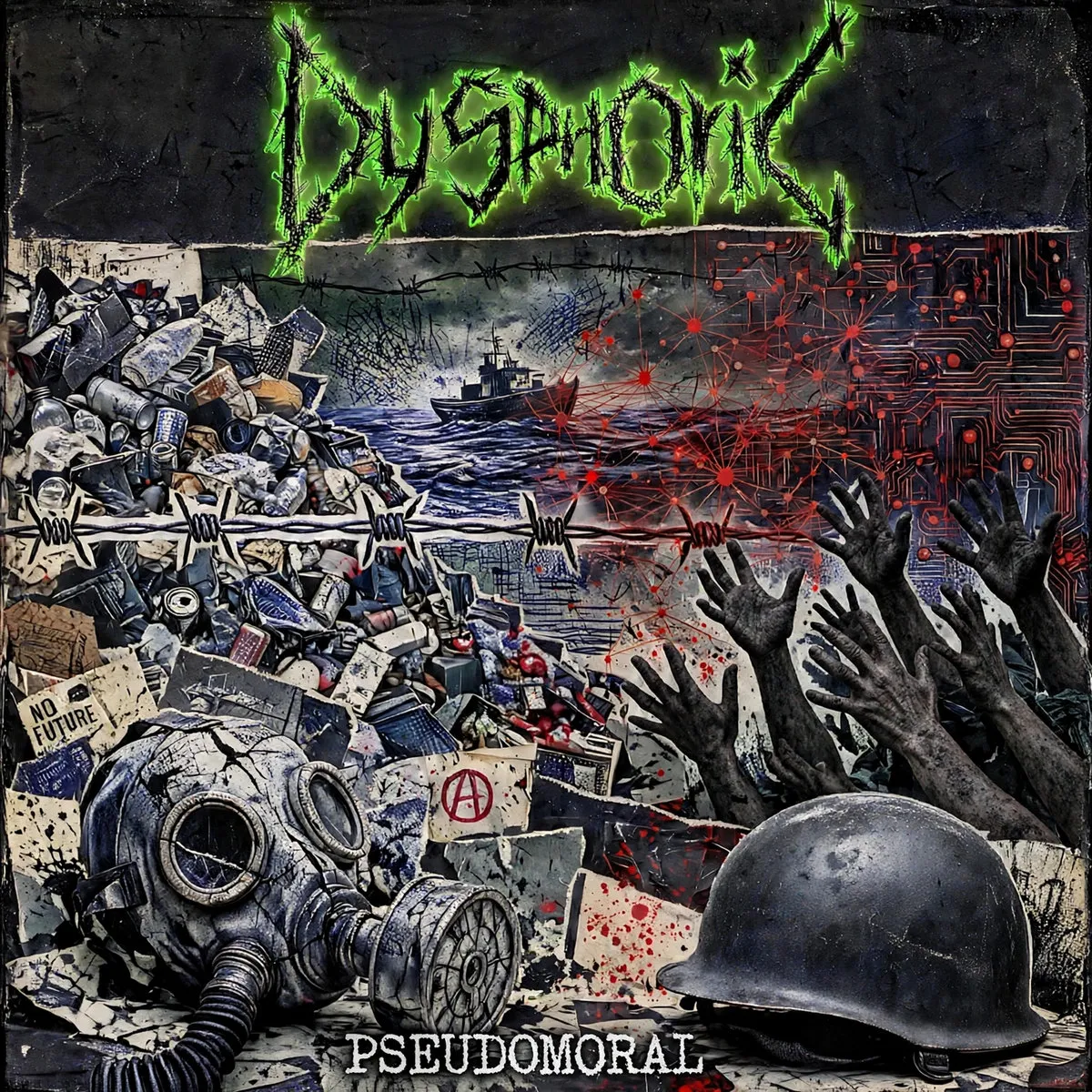
 The song titles tell you the record before the music does. “Frontex”. “Ungeziefer Mensch”. “Mit Beifall in den Tod”. “Digitale Einsamkeit”. “Gain of Function”. The sleeve is a collage of landfill, barbed wire, a gas mask, a steel helmet and a boat on open water, with a circled A and a torn “NO FUTURE” in the rubble. There is no guessing involved in what this band is about, and no coyness either.
Pseudomoral is the first album from the Dresden four-piece, who formed in 2022 and put out a demo called Mehr Zeit für Shopping im Leben in 2024. That title is now track three here. They play under the names Manu, Grindthor, Locke and Chefkoch, which is its own small statement about what matters in this corner of music.
Updated 7 October 2026. After this went up the band got in touch, and then corrected us twice, which is why the credits here are more precise than they were. Grindthor plays guitar, mixed the record himself at home, and had a hand in writing several of the songs. Locke wrote the music, and the lyrics are Locke’s and Chefkoch’s. Grindthor’s background is post-rock and progressive rock rather than grind. Nothing above or below has been rewritten and the rating is unchanged. The new material sits in its own paragraph further down.
Fourteen songs in twenty-three minutes. The longest is “Nightmare” at two and a half, the shortest is “Ungeziefer Mensch” at fifty-four seconds, and the German and English titles sit next to each other without any apparent system.
The thing that surprised me
Grind records are usually squashed. The genre has made peace with it: you want a solid wall, you push the master until it is one, and the loss of detail is part of the deal. This one has not been pushed. Peaks sit around fourteen and a half decibels above average, and the whole record runs quieter in average level than either of the other two albums on today’s slate.
What that buys is audible: the snare keeps its crack instead of becoming part of the texture, and the fast riff changes stay legible rather than smearing into noise. It is a conscious choice and it is the right one. A band playing this fast needs the headroom more than it needs the loudness.
The band have since told us who made that choice and where it comes from, and it is a better story than the one we assumed. Grindthor, who plays guitar here and had a hand in writing several of these songs, mixed the album himself at home. His background is post-rock and progressive rock rather than grind, though he has been listening hard to death metal since he was fourteen or fifteen, and he reckons you can hear that background in the melodic passages. The lineage makes sense of the measurement. Someone who learned to mix music in which a quiet passage has to survive is exactly the person who leaves fourteen and a half decibels of headroom on a grindcore record instead of pushing it flat. The restraint is not studio caution, it is a habit carried in from another kind of music.
The last two tracks do something the other twelve do not. “Nightmare” is the longest song here and the darkest, the one place the record slows down and sits in its own low end. It is followed directly by “In Grind we trust”, which is the brightest and most cutting thing on the album by a distance, a quarter of its energy above five kilohertz. Going from the murkiest track straight into the sharpest one, and closing a record called Pseudomoral on a title like that, is not an accident.
“Jeder Gott” opens on a dry spoken sample before the band arrives, and it is by a wide margin the most dynamic thing on the album, which is exactly what that kind of entrance does to a measurement.
What it costs
Eleven of the fourteen tracks hold a narrow range between their quiet and their loud passages, and that is the form working as intended rather than a fault, because relentlessness is the point of grind and a record that kept opening up would stop being one. The real cost is differentiation. “Jeder Gott” and “Ungeziefer Mensch” stand out because the twelve around them do not, and through the middle stretch the songs start to register as one continuous argument rather than as separate ones. On a twenty-three minute album that matters less than it would on forty, but it is there.
So
Recommended, and not only to people who already own a lot of crust. This is a band with something specific to say, playing fast enough to mean it, on a record that has been mastered with actual care in a genre where that is rare. The reservation is that the middle blurs and you will remember the record as a block rather than as songs. Start with “Jeder Gott” and “In Grind we trust”, and if “Frontex” does not tell you whether you want the rest, nothing will.
The master is the headline. Peaks run between 13.7 and 14.9 decibels above average across all fourteen tracks, with a median of 14.5, which puts this among the least compressed records in our measurement set. Average level sits between minus 14.2 and minus 15.6 decibels, a notably quiet master. Dynamic range within tracks is narrow as the form requires, a median of 8.4 decibels between quietest and loudest passage, with two clear exceptions: “Jeder Gott” at 22.2 and “Ungeziefer Mensch” at 20.2, the latter being the shortest song on the record at fifty-four seconds. The tonal centres hold between 2569 and 2871 hertz for thirteen of the fourteen tracks without any trend across the running order, and then the closer “In Grind we trust” jumps to 3123. It also holds the highest treble share at 25.3 percent against 16.5 to 22.5 for the rest, and it follows “Nightmare”, which is the darkest track at 2569 and the lowest in treble at 16.5. The low midrange stays between 11.5 and 13.4 percent throughout, the thinnest of the three albums in today’s batch, which is what keeps the fast passages readable instead of muddy.
Standout tracks: Jeder Gott, In Grind we trust, Frontex