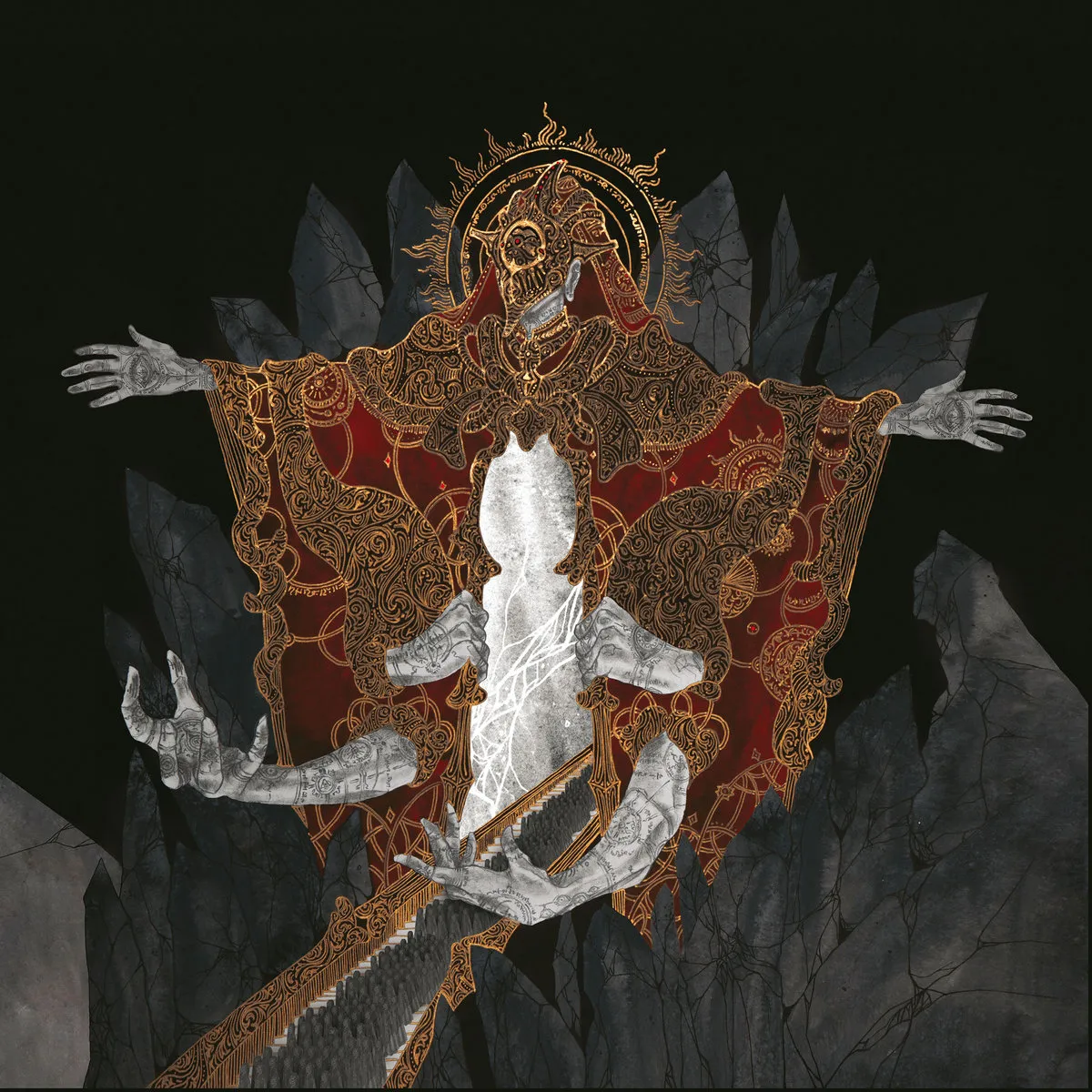
Edinburgh’s five-piece Dvne arrives at their third album trailing two impressive records: the sharp debut Asheran and the sprawling, ambitious Etemen Ænka. Voidkind, released in April 2024 on Metal Blade Records, makes a deliberate pivot. Where Etemen Ænka embraced space and accumulation, Voidkind pulls in tighter, favoring impact over atmosphere.
“Summa Blasphemia” announces the change immediately. It opens without ceremony, the song is in the room with you before you’ve registered it starting. The riff pattern at its core loops with a deliberate twist on its second pass, a small piece of sleight of hand that gives the track a sense of intelligence beneath the weight. When the vocals arrive they’ve noticeably gained confidence since the last record; cleaner and more assured, they sit squarely on top of the music rather than searching for a landing spot.
“Eleonora” is the record’s standout and its most patient piece. Eight and a half minutes, structured in halves: a careful opening section that takes its time building, followed by a midsection that constructs an ascent so methodically that when it finally breaks open, the release feels earned rather than sudden. The keyboards, new to Dvne’s lineup on this record, appear briefly here, threading through the upper register without dominating, contributing texture rather than color.
“Reaching for Telos” and “Reliquary” carry the album’s midsection with purpose, the former taut and driving, the latter opening into longer phrases before settling into a slow, deliberate groove. Two short instrumental pieces, “Path of Dust” and “Path of Ether”, divide the album’s heavier sections without demanding much attention on their own, more like cleared airspace than actual songs.
“Sarmatæ” is the most compact piece on the record, four and a half minutes of staccato riffs and multi-part arrangements that show the band at their most precise. “Abode of the Perfect Soul” follows with different logic: an opening salvo that hits immediately, then opens into a more spacious middle section, rotating between force and stillness in a way that feels almost conversational. It’s the track that best demonstrates why Dvne can pull off this more direct approach, when the dynamics are working, even a shorter build carries the weight of a much longer one.
“Plērōma” has the album’s most sustained melodic arc, six minutes that develop across their full length without the sudden gear-shifts of the earlier material. By the time “Cobalt Sun Necropolis” arrives, the record has done its heavy lifting. The closer runs nearly ten minutes and carries a strong atmosphere, though it takes longer to find its centre than the songs around it. The static-wall ending is striking in isolation but abrupt in context, which is a small wound on an otherwise well-sequenced record.
One legitimate complaint: the production keeps the drums flat in the mix in a way that blunts their impact. Drummer Dudley Tait is capable of more than the recording reflects, and the album would hit considerably harder with more air around the kit.
None of this stops Voidkind from being a strong record. The songwriting holds across the full length, the band’s command of tension and release is real, and tracks like “Eleonora” and “Abode of the Perfect Soul” are among the best things Dvne have committed to tape.
Standout tracks: Eleonora, Abode of the Perfect Soul, Sarmatæ
Dvne didn’t come back softer. Voidkind is a harder, more focused record than anything before it, and mostly, that’s exactly what it needed to be.


