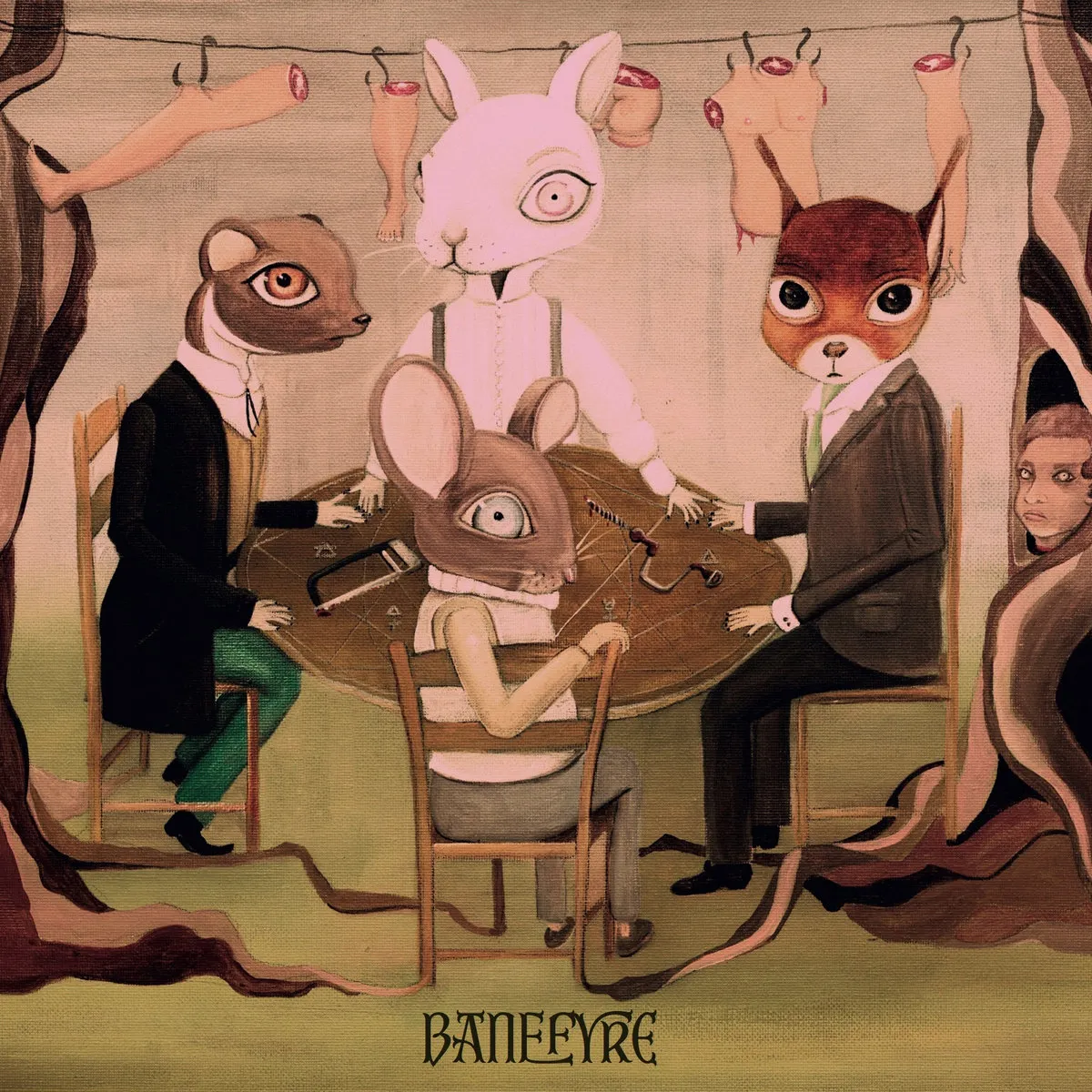
Justin Greaves has never been interested in making simple records. Since founding Crippled Black Phoenix in 2004, he has built a catalog defined by restlessness, lineups that shift, running times that sprawl, songs that refuse to behave. Banefyre is his twelfth studio effort and his most theatrical, released in its full “Musical” form in November 2022 with fourteen tracks, a cast of five principal voices, and original paintings by keyboardist Lucy Marshall. It is also, against most odds, one of the band’s most cohesive records.
The album opens with an instrumental that sets the temperature, something grey and patient, the kind of slow-building post-rock architecture that CBP have been good at for twenty years. What follows is harder to categorize. The second track tells the story of a young woman accused of witchcraft, her only crime being “peculiar in her ways,” ending in fire. The imagery is unambiguous and the arrangement matches it: the song reaches a kind of furious resignation, neither anthemic nor hopeless, just clear-eyed about what people do to things they don’t understand. Belinda Kordic handles vocal duties here and she carries the song’s center of gravity entirely on her own, her voice sitting somewhere between folk singer and force of nature.
Third track arrives in Swedish, “I evighet vi vandra, utan mål oändlighet” (in eternity we wander, without purpose, endlessly), a chant that works like a palate cleanser, or maybe a thesis statement. The album circles mortality throughout, sometimes directly, sometimes obliquely. “Blackout77” reconstructs the 1977 New York blackout and its ripple of riots into something that feels almost joyful, a lightning strike, a skyline going dark, and suddenly for one night the underclass feels genuinely alive. The melody doesn’t glorify the destruction; it just refuses to pretend the moment didn’t happen.
The production deserves attention. Kurt Ballou mixed the record at God City Studio, and the mix has his fingerprints on it in the best sense: everything is present and loud without losing warmth, and the album’s quieter moments, and there are many, especially in the back half, have genuine weight rather than disappearing into the room. Magnus Lindberg mastered, and the record sits well at volume.
Where the album earns its rating and then has to defend it is in its ambition relative to its execution. At fourteen tracks it sprawls, and the midsection loses some of the structural clarity the opening has in abundance. The mental health meditation in track eleven, “I’m okay, I’m just not alright”, is one of the album’s most direct moments and one of its best, but it arrives after several songs that feel more like movement between ideas than ideas themselves. The closing death meditation, with its image of being “just a teardrop in the Atlantic Sea,” recovers the thread and ends the record with exactly the gravity it needs.
Banefyre is not a casual record. It asks for patience, for repeat listens, for the willingness to sit inside a song that doesn’t resolve quickly. But the rewards are there, in Kordic’s voice, in the way the record holds its moral seriousness without ever becoming preachy, in Greaves’s stubborn belief that rock music can still do something worth doing.
Standout tracks: Blackout77, Little Liza (Into The Fire), I’m Okay (I’m Just Not Alright)


