 Bandcamp
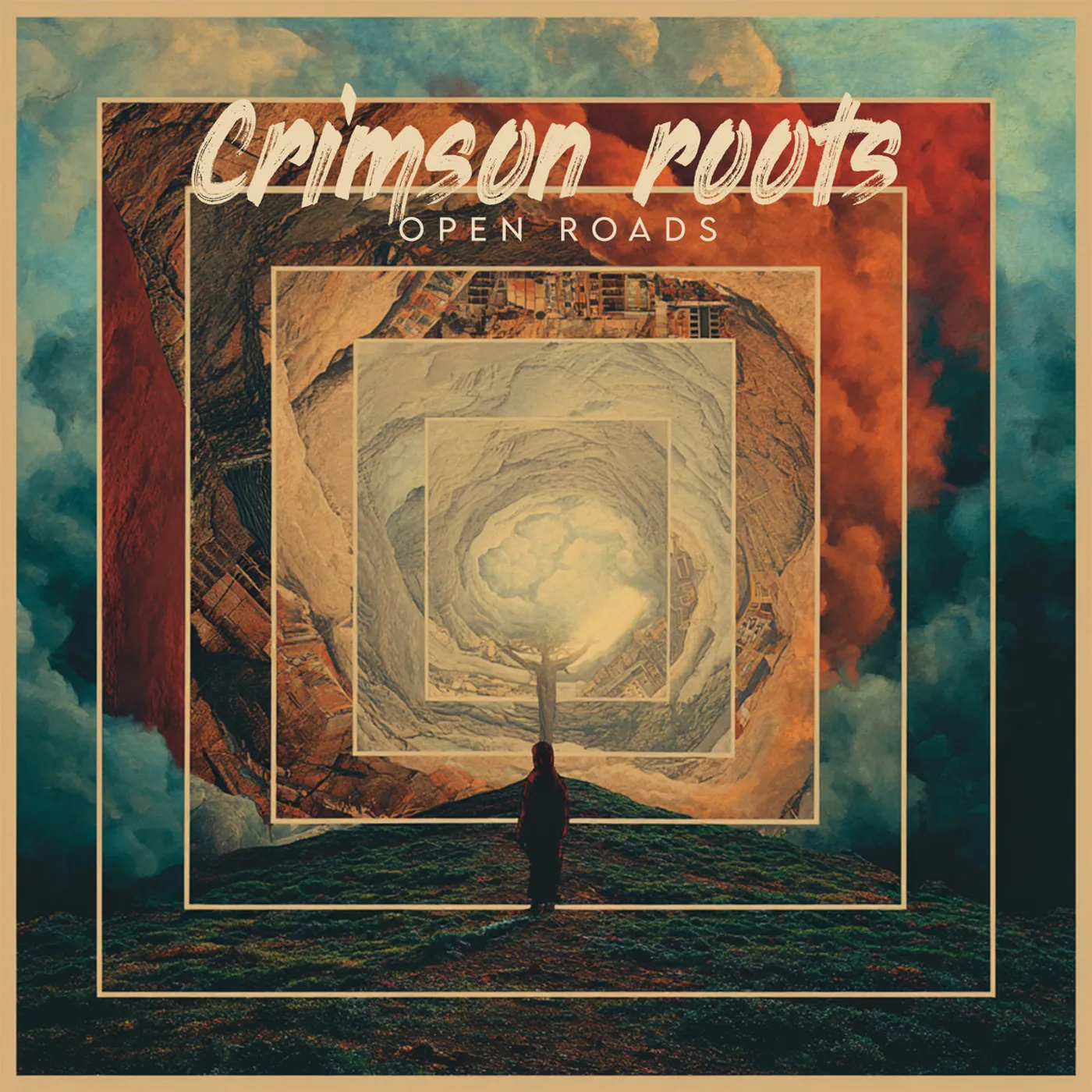
 The cover tells you the shape of the thing before a note plays: a lone figure on a green hill, facing a tunnel of nested landscapes that fold inward toward a pale horizon. Open Roads is a journey record, eleven songs the band frames as one traveler’s passage through distance, change and self-discovery, and almost every title points the same direction. “Drifting,” “Steps,” “Nowhere,” “The Crossing,” “Mountain.” It is the kind of organizing idea that can either give an album a spine or turn it into a themed playlist, and Crimson Roots, a five-piece out of Nuremberg signed to Tonzonen, land somewhere in between.
What holds it together is Ina Salaj. Her voice is the first thing you hear on “Drifting” and it never leaves the front of the mix: clean, perfectly pitched, intimate, intelligible to the syllable. On the title track and “Falling Through” she is genuinely the reason the songs work, riding a verse-to-chorus swell that the band trusts to do the structural lifting instead of reaching for volume. “The Crossing” and its second part run the same trick, dense choruses opening into airier verses, and when the band lets a song breathe like that the writing feels unhurried in the way the press kit promises.
The Polish Question
The tags on the Bandcamp page are blues rock, classic rock, retro soul. That is the band’s self-image, and it is where the record runs into its one real reservation. This is a strikingly clean production. The channel separation is surgical, the drums often read as triggered and sample-tightened, the cymbals are filed down so nothing ever bites, and Salaj’s voice sits so far on top of the band that it can feel sealed off from it. For a soul-leaning blues-rock record, that clinical finish works against the music’s own instincts. The bass fills the bottom precisely but never growls, the guitars stay readable rather than dirty, and a few tracks (“Steps,” “The Tower,” “Mountain”) get pushed hard into modern loudness, flattening the contrast the arrangements set up. The songs that survive best, “Open Roads,” “Falling Through,” “The Crossing,” are the ones the master leaves alone, where the quiet-to-loud move still has air around it.
The other limitation is one the band half-acknowledges in the writing itself: the arrangements are predictable. You can usually hear the chorus coming, the soft intro arriving on schedule, the lift landing where a lift is supposed to land. None of it is badly done. It is competent in a way that rarely surprises, and for a debut that is a fair place to be.
The defining choice here is how forward and how clean the vocals are. Salaj sits dead center, dry and present, maximally intelligible, which flatters the singing but can leave the band sounding like a backing track behind her. Underneath, the mix is transparent and tidy almost to a fault: bright snare with a quick room, clicky defined kick, cymbals rolled off before they ever get harsh, guitars with readable note separation and a controlled, slightly digital saturation. The bass is accurate but tame, more foundation than voice, with none of the grit the blues-rock framing wants. Dynamically the record splits: “Open Roads,” “Falling Through” and “The Crossing” keep real headroom and breathe, while “Steps,” “The Tower,” “Mountain” and “The Crossing: Part II” get squeezed toward maximum loudness, stacking up in the low mids and losing depth in the loud sections. It is a record that sounds expensive and slightly sterile at the same time.
Standout tracks: Open Roads for the verse-to-chorus swell that proves the band’s instincts. Falling Through for the most dynamic, best-breathing mix on the record. The Crossing for the way it carries the journey idea without leaning on it.
A debut that gets the singer and the songwriting right and the finish slightly wrong. Salaj is a real voice and the bones of these songs are good, but the production sands off exactly the dirt that blues and soul live on, and the arrangements rarely break their own pattern. Three stars, and a band worth checking back on when the vinyl lands through Tonzonen, because the ceiling here is clearly higher than the master lets you hear.