Interview · 16 October 2026
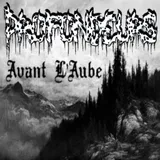
Our review read the ninth track as architecture: an interlude that measurably changes the record on either side of it, and that we assumed had been built to do exactly that. It had not. The piece was written, recorded and mixed by bassist and drummer Samuel Bibeau before the album sessions started, and it went on the record because it fitted. S., who answered in French and asked to be named only by the initial, also corrects the credits: on two tracks the guitars are played by the bassist, which explains a measurement we could not account for. Along the way he explains the saxophone, and why a band that calls itself post black metal left out blast beats and occult imagery on purpose. Answers were given in French and translated here; S. read and approved the English before publication.
Twenty tracks in forty-eight minutes, the longest under four. This genre normally works the other way round. Was the short form a decision you made before you started writing, or something the material forced on you?
S.: Yes, the choice to do 20 tracks was deliberate, it was a goal we set ourselves right from the start. As for the length of the tracks, I would say that happened organically, without any precise timing in mind. That said, I admit I tend to write shorter pieces that grab the listener’s attention from the start without dragging on unnecessarily.
A two-minute song has no room to arrive. Did writing at that length change what you could put in a song, and did you lose anything you missed?
S.: No, nothing was lost at all. On the contrary, the further the process went the more we tended to add things into the tracks, and we never once said “ah, we have to cut this or that part because the song is going to be too long”.
”Sur Le Chemin Du Grand Pré” is listed as an interlude, but the album sounds different on either side of it. Was that architecture, or did you discover it afterwards in the sequencing?
S.: I would say that at the start we knew we were going to do interludes, but we did not yet know exactly what we would do inside them. The first, “Sur Le Chemin Du Grand Pré”, is an original composition by my bassist and drummer Samuel Bibeau. He recorded and mixed it himself before we recorded the album, and listening to it I thought it was beautiful and that it would fit the atmosphere of the album. For the second, “Les Marais”, the recording and the writing were done in one evening, at Sainte-Anne-de-Sorel, with the collaboration of Alexis-Charles Lafond, a talented pianist and friend of the band. For this one I had a slightly clearer idea of what I wanted: something dark, atmospheric, that was going to be a bridge towards the darker tracks on the album.
”La Pluie Froide De Novembre” opens wider between its quietest and its loudest passage than any single track in our entire measurement set. Was that played that way in the room, or built in the mix?
S.: On this composition in particular we wanted to do things a little differently. First of all, the entirety of the guitars was recorded and written by Samuel Bibeau, who is normally on bass and drums, so right there we already had a contrast with the other tracks (with the exception of “Confusion”, which is also a composition of his). You find this kind of contrast with bands like Lifelover, Bethlehem, Silencer, who are influences on the band.
Youri Paul-Goulet is credited with saxophone. What did you want from it, and did you know where it would go before he played?
S.: The aim was to do things differently, and that is a philosophy that guided the whole process of the album. Profondeurs being a POST black metal band, it was obvious we were not going to follow the codes of the genre. That is also why we made the choice not to put blast beats in our music, or occult elements in our imagery. To come back to the saxophone: yes, I knew the place I wanted it to have. I wanted it to genuinely bring something to the songs and bring a different flavour, a bit like Carpathian Forest did with the track “Cold Comfort”.
This is the fifth album since 2023, from a project that started in 2022. Does writing that often change what a record is for, and is there a version of Profondeurs that waits three years between albums?
S.: The pace and the volume may look high at first glance, but for me it is my normal cruising speed, in the sense that I have always been a fairly productive artist and I rarely suffer from blank page syndrome, so no, it does not really change what a record is for. As for waiting longer between each release, I do not really see myself waiting very long, especially if the material is ready to be shared. That said, we do not know what the future of Profondeurs will look like, because after 5 albums we will obviously be looking to renew ourselves and explore different sounds and influences.
A note on the translation. S. answered in French and asked that we handle the English. We translated close to what he wrote rather than smoothing it into magazine prose, and left “blank page syndrome” as the literal rendering of “syndrome de la page blanche” because the image is his. He read the full English text before this page went up and approved it.