Interview · 28 September 2026
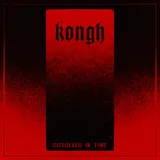
Our review called the thirteen year gap the story and the patience the method. David Johansson's answers make the first part look far too simple. The band did not wait for the right moment, they were finished: three albums that did what Kongh set out to do, a slow drift apart, and no plan. What brought it back was a single riff written around 2015 that he could not stop thinking about. The album proper took six months, from November 2025 to May 2026. Along the way he explains why the vocals sit where they sit, why the shortest song on the record is also its oldest, and which Nirvana album the mix is chasing.
Thirteen years is a long gap, and plenty of bands come back because a window opened rather than because they had something to say. What made this the moment, and was there a point where it became clear the record was actually going to exist?
We released our last album before the break in 2013, but we continued to play live sporadically until 2017. After 2013, there was no concrete plan for how we would continue, but I had a general feeling that we were quite “finished” with Kongh at that point. We had been working very intensively since the start in 2004. During that period, we managed to make three albums that I think fulfill the goals and visions we had for Kongh from the beginning. In addition, we were probably generally tired and needed to focus on other things in life. After a while, I began to regard Kongh as more or less concluded, but there was always a small thought that it would be fun to do something more. The uphill battle, however, felt quite large given that we in the band had started to drift apart.
But the thing with me is that I always have music in my head. I go around thinking about ideas here and there, and eventually, enough ideas had accumulated to feel that a new Kongh album should be made. I started by writing Staining The Ether and recording a demo of it around 2022. It felt good, I liked the song, but there were still a lot of things around Kongh that needed to be sorted out, various business matters and which musicians would be involved in the project. But I started to tackle those things, and in 2025 it felt like I was ready to start working on a new release for real. At first, I thought I might just make an EP with Staining The Ether, but since it was almost 20 minutes long, I made an album instead when one was already halfway there. The basic idea for the other two songs already existed, I just needed to polish them a bit. It was in November 2025 that I started working properly on the album and decided that it would really happen, and everything was finished in May 2026.
”Staining the Ether” spends more than five minutes before a voice arrives. Was that shape there from the first sketch, or did the opening grow as you worked on it?
The song has had a fairly long journey. It started with me writing the main riff around 2015. I wrote the quiet intro section and the heavy main riff and recorded a short demo of it, then I didn’t touch it for a year or so. But I kept thinking about that riff from time to time because I thought it was such a cool riff. That particular riff felt like the gateway into the next chapter somehow. I had the feeling that if Kongh were to return, this would be an important riff for the direction of the new songs.
The more I thought about it, the more ideas I got. The concept of the song grew and became bigger and bigger. In 2022, I sat down for the first time and recorded a serious demo of all the ideas. By then, I had the first 10 minutes of the song. “Is it finished now?” I wondered, but it didn’t feel finished. I wanted this song to be as much Kongh as possible, a gift to those who appreciate the essence of Kongh. A symbol of what has always been the core of Kongh, heaviness, uncompromisingness, unpredictability. Like, people have waited for 13 years, better give them something worth the wait.
You play almost everything on this record. When there is nobody in the room to argue with a part, what changes about how a riff turns into a song? And what do you lose that a full band would have given you?
Having multiple songwriters was important for Kongh in the past, when we functioned more like a band where several of us contributed and helped find our sound. Twenty years ago, I couldn’t have written Kongh songs entirely on my own. My collaboration with Tomas (founding member and drummer) is what allowed us to develop our sound. But today, the situation is a bit different. I am a more experienced musician, producer, and songwriter. And I have a much more established and developed idea of how Kongh songs should work, and how to write a Kongh song. Nowadays, it is probably my favorite way to write music, entirely on my own, in my home studio. It works well. I don’t even know how it would work to write Kongh songs with other people anymore. Maybe I will try in the future, maybe not. We’ll see!
The vocals sit deep in the mix, closer to a texture than a lead. Was that settled while writing, or did it happen at the mixing stage once you heard how much room the guitars needed?
It was decided in the mixing stage. Kongh’s music should feel like a wall of sound, so it is always important that the guitar and bass take up plenty of space. But I don’t want the vocals to be completely buried either. It is important to find the perfect balance where the vocals are clearly heard without dominating too much.
”Guided to the End” is the shortest and brightest thing here and it sits between two long pieces. Did it get written as a contrast to them, or did it exist first and find its place later?
It was actually the last song written and performed together before the band was put on hold. I think we played it live once in Gothenburg in 2015, at a show together with Monolord and Pelican. It was the only song written in the period from after Sole Creation was recorded in 2012 until we completely stopped in 2017. However, it was an early version with a completely different chorus, bridge, and outro. I picked the song up again last winter when I was finishing the album and finalized it. I felt that there was some potential for improvement in the original version. It works well as a bridge between Staining The Ether and Dissolved In Time, since it is quite catchy and direct, while the others are more complex and experimental in their structure.
The record has not been flattened. The distance between the quiet passages and the heavy ones stays wide, which in this genre usually loses out to sheer level. Was that something you had to defend to anyone, or was it never in question?
I find the dynamics between quiet and loud sections interesting, and that has always been a big part of Kongh’s identity. When I mixed the album, I tried to make all the elements sound heavy and powerful while still preserving a clarity where everything sounds clear and distinct. I wanted it to sound heavy and raw without everything sounding like a distorted blur. An album I have listened to a lot and been inspired by the production of is In Utero by Nirvana. It sounds just the right amount of raw and dirty but still organic and clear.