Interview · 25 September 2026
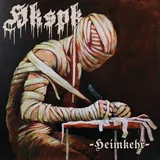
We reviewed Heimkehr in September and spent most of the piece on the one thing the record refuses to do, which is let any of the suffering buy something. We also wrote that it sounded like an album built in pieces. Jim's answers take that apart: the shifts in production are deliberate, they follow the record's move from death metal to black metal, and they were chosen song by song. Along the way we found out that one song was cut from the album for being too funny, that the long version of the band name was retired two years ago, and that fifty copies is a position rather than a budget.
HELLOKITTISCUMPORNKILLER was a joke, and so were Holy Scum and The Human Butcher to a degree. Heimkehr is not. Did the band walk into that shift deliberately, or did you look up one day and find you were writing something you could not put a gag on?
Just for clarification: two years ago, we changed our name to HKSPK. We don’t use the long version anymore.
A lot has happened in all our lives in this short space of time. School-leaving exams, the end of apprenticeships, the start of apprenticeships, university and personal circumstances. In other words: “The serious side of life has begun.” Well, as soon as the first letter from the tax office arrives, you automatically become more humble.
We’ve now been grappling with much more serious themes in our lyrics. For this reason, one song had to be cut from Heimkehr. It was too absurd and funny to fit on this album. Perhaps we’ll release it one day, who knows.
Venturing into more serious territory with the lyrics wasn’t a conscious decision. It felt good to let such themes flow into the music. That’s just how it happened.
Almost every record that touches war keeps one payoff in reserve, the last stand or the swelling finish that makes the suffering buy something. Yours ends open and offers nothing. Was there ever a version with a resolution that you wrote and threw out, or was the refusal the starting point?
It was the starting point. It’s just like real life, you never come back the same. And it does not always have to be war. It could be an expedition, an illness, working in a foreign country or some other personal situation.
You come back to the place that you are used to, but the experiences you’ve had somehow change you. Sometimes it’s difficult to share them because some people may not understand you.
What you make of it is entirely up to you, it’s an open ending.
”Kill The Weak” is the one title on the record that can be read badly, and you have said publicly it is a mantra of rage rather than a statement. What was the argument inside the band for keeping it, and was there one for dropping it?
We did not choose it as a title just because it sounds like a good mantra, we chose it because it sounds fucking sick! It’s easy to scream and very easy to spell.
The principle we use to choose our song titles is the same as the one we use to decide on the language of our lyrics. It’s all about the atmosphere. A German title or German lyrics simply wouldn’t have felt right.
The eight tracks do not share a sonic world. “Rot In Despair” has a real room around the kit, “Sonnenjäger” is loud and tightly compressed, “Rain In The Face” sounds like a rehearsal space. Was the album made in pieces over time, and given another run at it, would you unify it or keep the seams visible?
Basically, the album shifts from death metal to black metal. This ties in with the lyrical themes.
The reason the songs sound so different from each other production-wise is that we tried to connect with each song more directly and create a certain atmosphere. This isn’t only created through the song itself, but also through the mixing and mastering.
For example, a death metal song like Sonnenjäger sounds so much heavier with punchy, compressed drums.
”Rain In The Face” reaches for a Lakota leader and the aftermath of the Little Bighorn. You are a band from Frankfurt an der Oder, a town with plenty of its own material about soldiers and the ground they fought over. What made a nineteenth century American story the better vehicle?
The legend of Rain In The Face has been with our guitarist Leon since his childhood, and he always thought about dedicating a song to him.
I mean, a leader who kills 80 people alongside two other leaders and rips out the heart of his biggest enemy? That sounds pretty black metal to me (haha).
Native American history has never really gained much recognition in the metal scene, except for “Indians” by Anthrax. But that’s basically it. We didn’t necessarily try to change that, but we wanted to try something we hadn’t done before.
Someday, we’ll explore our local history as well.
Fifty physical copies, no label, everything done in house. If a label offered to press two thousand and take the record out of your hands, would that be a win or a loss?
The fifty copies are definitely intentional, even if the circumstances shape what’s possible. We’re doing everything ourselves because we want to keep the whole process close, from recording and artwork to pressing and distribution. There’s something important to us about knowing exactly where the record comes from and where it ends up.
If a label offered to press two thousand copies and take the record out of our hands, it wouldn’t automatically be a win. The extra reach and resources could be great, but if it meant losing control over the music, the physical release, or the way we communicate with people, then we’d have to think twice. For us, the point isn’t simply to make as many copies as possible. It’s to make something that still feels like ours.
So I guess fifty copies right now is less a limitation than a statement of how we want to operate. If the right label came along and understood that, though, we wouldn’t be against working together. It would have to feel like an extension of what we’re already doing, rather than someone taking the record away from us.