Interview · 26 September 2026
Our review called Western Wilderness sun-baked desert stoner from a Mediterranean island and treated the contradiction as the charm. Andrea, Guido and Dam take it apart: the desert is not a metaphor they borrowed from California, it is a mining basin an hour from Cagliari that they have been camping in since they were teenagers, and one of them now owns a house in one of the abandoned villages. Along the way they explain why the un-brickwalled production was the natural choice rather than a statement, what the seven minute centrepiece owes to a Sardinian novel about a tribe landing on an empty island three and a half thousand years ago, and why every record they have made was drawn by the same friend.
Western Wilderness draws on Sardinia’s abandoned mining villages, nature crawling back over what people dug out. What pulled you toward that image, and how did it shape the writing?
These places have left a deep mark on our collective imagination. Specifically, we are talking about a mining region in south-western Sardinia, just over an hour’s drive from Cagliari, our town. Montevecchio, Piscinas, Ingurtosu and also the Sulcis form a mining basin that has been active since ancient times and has largely been disused for several decades now. Today, many of these places lie abandoned, nestled amongst wild beaches, gigantic dunes, mountains and forests. They are places rich in atmosphere, far from the hustle and bustle of city life, which we have been visiting since we were little more than teenagers. In spring and summer, we used to go camping there with our groups of friends, enjoying campfires and as much beer as we fancied. For a few years now, our band-mate Andrea has also owned a house in one of these splendid ancient villages.
After a concept album you went back to basics here. What made that the right move, and did it change how you write together as a trio?
Our previous album, Lords of Galaxia, is a concept album. On that album, many elements of space rock were incorporated into our riffs through the use of synthesiser parts. We wrote the lyrics drawing inspiration from Asimov’s science fiction and the “ancient astronaut” theories of alternative history. These are highly evocative themes, which gave rise to a beautiful yet highly structured album, characterised by very long tracks. With this fourth album, we decided to return to a more instinctive and fluid approach to composition, writing tracks that are more direct and focused. The lyrics were also written in a more instinctive way. At a certain point, however, a common narrative emerged that gives the album a sense of cohesion.
The record is strikingly dynamic and un-brickwalled, it genuinely breathes. Was that a conscious push against the loudness norm, and how much came down to working with Electric Valley?
For us, working in this way felt completely natural. We tried to recreate in the recording the sonic dynamics we usually use when playing live. In collaboration with Paolo Mulas, the sound engineer who oversaw the recording, mixing and mastering, we worked hard to achieve a full, powerful sound that still respected the dynamic range of the tracks. We’ve built a relationship with Electric Valley based on mutual respect and trust; we were given complete freedom to choose how and where to record. What’s more, they did an excellent job with the vinyl pressing and the beautiful artwork created for us by Inkline.
”Towers of Silence” is the seven-minute heart of the album, that intimate intro opening into the heavy part. How did that one come together?
“Towers of Silence” is the most unconventional track on the album; it consists of at least two movements and is a short suite. There is a highly evocative section of interwoven rhythmic arpeggios that repeats like a mantra. The rhythm section intensifies; there is a long guitar solo by Andrea which has a dreamlike atmosphere, somewhere between Middle Eastern and Mediterranean. The track reaches its climax before bursting into electric riffs, with the drums and bass changing tempo. The lyrics are loosely based on a novel by the Sardinian writer Sergio Atzeni, a fantasy story set around 3,500 years ago. A tribe fleeing by sea from Mesopotamia lands on an uninhabited Sardinia and founds a peaceful community living in harmony with Nature.
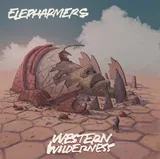
The cover, that enormous face inside a cracked astronaut’s helmet half-buried in the desert, with the tiny kid on a BMX rolling up to it, nails the surreal but warm tone of the record. Where did that image come from, and who made it?
Ever since we started out as a band, all our artwork has been created by Inkline (Andrea Cara), a professional illustrator from our town, as well as a dear friend and collaborator. We always discuss ideas together, but he has complete freedom when it comes to drawing. We discussed the atmosphere of the album and the lyrics with him, and he listened to the tracks during the pre-production phase. I think these illustrations manage to capture the album’s themes in a surreal way: vast, desolate spaces where the mind wanders freely.
Desert stoner from an island in the Mediterranean is a lovely contradiction. How much does Sardinia itself, its light, its space, its isolation, live in your sound?
The answer is tied to the first question in this interview. We have our own little deserts of sand and salt, our own dunes, and our own abandoned industrial villages. Kilometers of roads in the middle of a fantastic nothingness. We have centuries-old forests and mysterious, silent archaeological sites dating back millennia. Our sound and imagery have found a natural affinity with the California desert stoner scene.